ALL EARS: BIG EARS 2025 [DAY 2]
Day 2 of our extensive coverage of the Knoxville music and art festival includes The Nels Cline Singers, Yo La Tengo wth Sun Ra Arkestra, Eucademix, and Les Claypool Bastard Jazz

GAS FOOD LODGING
I took an Uber downtown by myself to see The Nels Cline Singers on Friday. We’d stayed up far too late, and nobody else was ready to pull it together. My driver, Amanda, got me down to The Mill & Mine with time to spare, and the ride was only about $13. I was warned that hotel prices are crazy over Big Ears weekend, if you don’t jump on them early. That may be true, but there are plenty of rentals available for cheap outside of downtown. I found one on VRBO that accommodates 8-10 people for $180 a night. Rideshares were easy, and there is even cheap, if not free, parking available for anyone who doesn’t plan to get drunk and wants to drive themselves to the festival.
Unless you get lucky, the Knoxville airport can present issues for those flying from the West Coast, or likely any relative distance. The flights are expensive and generally require layovers, pushing them to a good 9 hours or more from Seattle. Meanwhile, flights to Nashville were less than half the time and price. It can actually be quicker, cheaper, and more efficient to fly into the Music City and take the 3hr drive from there. Since I have a friend in Nashville who was coming with me, I didn’t even have to rent a vehicle. For the most part, the majority of concerns aren’t real issues, even for someone like me who tends to do everything last-minute. Add the fact that you can casually stroll around Knoxville buying food and beer from local establishments, and you’re saving money while getting higher quality products than the typical corporate festivals that fence you in like livestock.
If there’s one thing to be aware of, it’s the way that certain bracelets provide certain access and privileges at multi-venue festivals such as this. Places fill up, and the dedicated line for those with higher-tier passes makes a difference. If you really want to ensure that you get into something, you’re going to need to show up extra early or throw down on premium or VIP wristbands. Having media access allowed me to get dropped off minutes before the Nels Cline set, go through the search, and still get into the photo pit without missing anything.
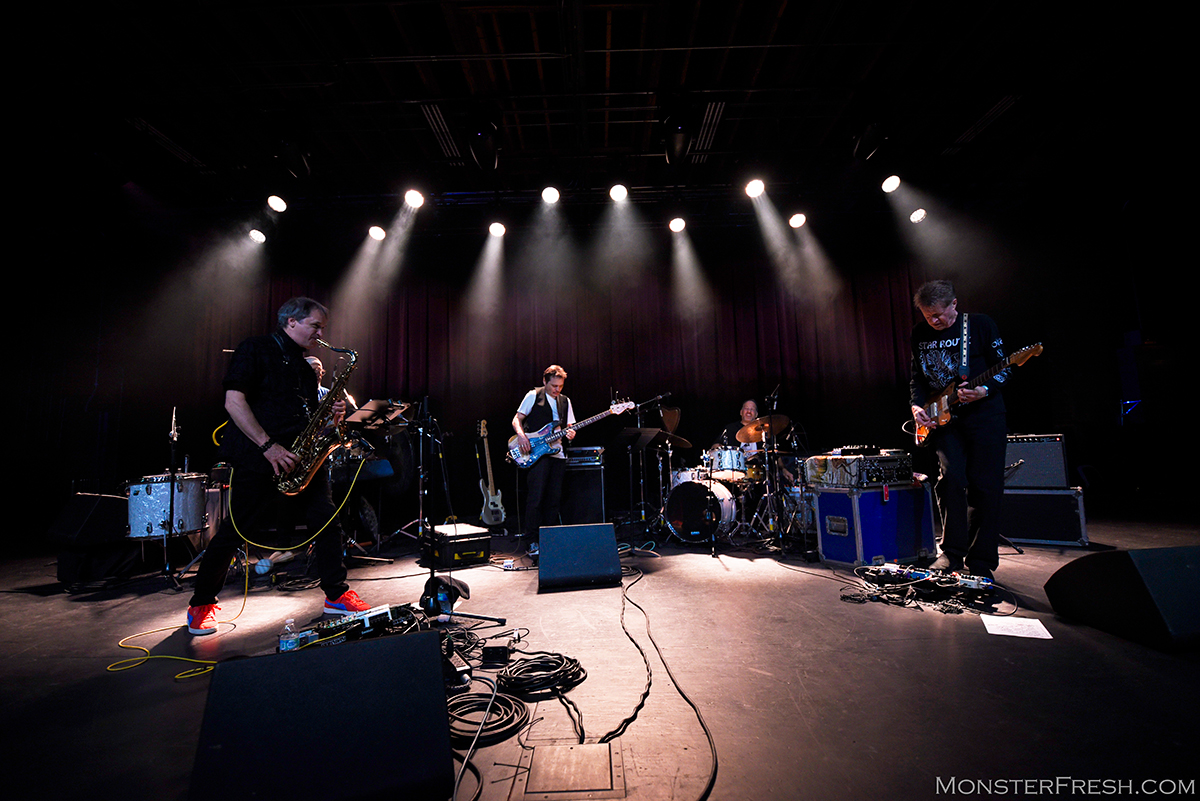
THE NELS CLINE SINGERS
Most widely known for playing guitar in WILCO since 2004, Nels Cline began by performing more jazz-oriented music in the 1980s. From there, he’s gone on to have an incredibly prolific career exploring various genres alongside an extended list of collaborators ranging from Mike Watt, Thurston Moore, Lee Renaldo, and Lydia Lunch to John Zorn, Tinariwen, Ornette Coleman, Tedeschi Trucks Band, and Blue Man Group. Cline has a history of collaborating with his wife, Japanese multi-instrumentalist/producer, Yuka Honda. Playing in Honda’s band, Cibo Matto, and performing alongside her in the Plastic Ono Band are just two examples of their work together. Yuka has even been part of The Nels Cline Singers in the past, but she wouldn’t be performing in the current incarnation at Big Ears. Her solo electronic project, Eucademix, was, however, on the festival schedule later in the day
Cline is one of a handful of musicians who led multiple projects throughout the weekend. I knew that I had to catch at least one of his sets and prioritized The Nels Cline Singers for its impressive lineup. Joining Nels were saxophonist, Skerik (Critters Buggin, Garage a Trois, Les Claypool); bassist, Trevor Dunn (Mr. Bungle, Fantomas, Melvins, John Zorn); drummer, Scott Amendola (Bill Frisell, Charlie Hunter, Ben Goldberg); and Brazilian percussionist, Cyro Baptista (Trey Anastasio Band, Caetano Veloso, Paul Simon). Although listed on the festival website, keyboardist Brian Marsella (John Zorn, Cyro Baptista’s Beat the Donkey, Jon Madof’s Zion80) was unable to make it.
This particular lineup of The Nels Cline Singers was featured on Share The Wealth, the group’s most recent studio LP from 2020. With responsibilities to other projects like Cline‘s Concentrik Quartet – also on the bill – and everything the other members are involved in, I’m not sure how often this entire group manages to assemble like this. For players of this caliber and versatility, any distance or time between them might actually be to their benefit. Regardless of whatever else they have on their plates or how many sets Cline had to do that weekend, their collective enthusiasm to be on that stage together was palpable. They know and trust each other’s abilities enough to be confident that any one of them can hang regardless of where they venture.
Stage right, Cline was positioned inward toward his collaborators, a captain weathering a sea of kraken. Dunn and Amendola‘s rhythm section supplied an airtight foundation, wrapping around and chasing one another in constant motion. Equipped with pedals and a table of effects, the bandleader would fill with steam before sending a blistering swarm of fingers across his guitar neck. Skerik zoned in on him, laughing in awe, until Nels gave the signal for the horn player to unleash a maniacal onslaught of his own. Somewhere between a shaman and an otherworldly prop comic, Cyro Baptista unveiled a never-ending array of percussive instruments from his station like a free jazz Brazilian Mary Poppins. A metal “thunder sheet,” agogo bells, jaw harp… anything one could imagine, Cyro has a sound for it. Cline hit the guitar strings with a stick and spoke into his pickups through the plastic “speaker” of a children’s toy. These loons met up in Knoxville to brew chaos. They were playing for each other as much as anyone.
Disparate sounds swirled and combined in pummling grooves, skronks, shattering glass, and crimson doom. Not only is the level of talent in this squad unreal, but their versatility as individuals allows them to halt on a dime and shift into any direction imaginable, from sludge to beauty, pinpoint precision, to unwieldy abstract maelstrom. Compositions would build and collapse, storm clouds opened and split the skies. A tune would begin like a giant waking from its slumber and sprinting down an erupting volcano past crashing waterfalls, while kaiju soared through an electrical storm overhead. It was a visceral experience directed by madmen.
RICH RUTH & ALLISON de GROOT
I’d been cautioned by more than one person that Boyd’s Jig & Reel fills up quickly and can be a difficult venue to squeeze into. I chose to take my chances anyway. The Scottish whiskey Pub doesn’t prioritize wristbands, so everyone stands in the same line. It was an equalizer.
I would learn later that advance notice of who is playing these “secret” shows is sent out to premier ticket holders, but by asking those around me, nobody seemed to know who they were in line for. I only knew because, weeks earlier, the artist informed me about it directly. This was puzzling. With so much other amazing stuff happening, why would anybody stand in line when they didn’t even know who it was for? I expressed my confusion to a young woman who happened to be an intern from a local paper. She informed me that, last year, one of the secret shows was Andre 3000. Perfect. My hope was that, once it became evident that this show was more “Appalachian Terry Riley” than ATLiens, enough people would clear out and make room inside the venue. Fortunately, that’s exactly how things panned out.
I stepped through the curtain to a back area with a collection of chairs set in front of a small stage. The rest of the space was standing room only. The performance had only just started. Banjoist, Allison De Groot was seated in the center, flanked on each side by Taro Yamazaki (bass) and Patrick M’Gonigle (fiddle). Behind her Parker James was standing at his vibraphone. As mentioned in part one of our festival review, all but Allison were part of the Rich Ruth performance the previous day. Ruth, himself, stood off to the right behind a table of synths and effects. His guitar was slung around his body.
Ruth‘s reference to this collab as an “Appalachian Terry Riley” was an apt enough description for something with no real comparison otherwise. The idea of merging two seemingly contrasting genres is intriguing for the experiment alone, but this material thrives on more than novelty. Even when it works, mishmashing styles often leaves some clear separation of where they begin and end. RUN DMC and Aerosmith broke ground when they teamed up in 1986, but the hip-hop and rock elements maintained some relatively defined parameters. What Ruth and de Groot cooked up in the back of that whiskey bar feels altogether new. More than a “You got your peanutbutter in my chocolate” situation, they were feeding us unique flavor profiles that push things beyond fusion into a whole new style of delicacy.
The initial surprise might be how seamlessly everything merges, but it’s less about separate worlds locking into one another and more about defying the limited scope collectively ascribed to particular instruments and musical styles. A frequent collaborator of Tatiana Hargreaves, Allison is no stranger to performing with a fiddle player, but M’Gonigle employed a less orthodox approach, playing drawn-out, sustained notes. Similarly, the vibraphone and electric bass worked to shape the music in ways that were more ethereal than rhythmic. If anything, de Groot‘s winding phrases ran the spine up the center, injecting the nervous system for the rest of the undulating soundwaves to wrap around and cling to. Her strings would move toward the forefront and then recede, disappearing back into the ripcurl. With his keys, nobs, the tasteful precision and effected guitar, Ruth would orchestrate swells and summon crashing tides to roll over the room.
This little secret show, which most people didn’t have on their radars, epitomizes the ethos of Big Ears to me, from the sharing of minds and marriage of worlds to the birthing of new universes. To watch these experiments take place so successfully by artists who are genuinely excited to test ideas and themselves is infectious. It’s a pure representation of the festival when an act challenges parameters to question how we understand instruments, genres, and musicians within the greater landscape of art and music.
From what I’ve witnessed, nobody loves or embodies Big Ears more than Rich Ruth, because nobody understands more about what it offers and represents. He ended the set by stating that if somebody had told him he’d be performing an ambient bluegrass set a year ago, he wouldn’t have believed them. While that may be true, he knew enough to hypothesize such a combination would work. Whether through a physical album or more shows in the future, I can only hope that we’ll see this project revisited.
THE NEWSPAPER INTERN
Somebody told me the average age of attendees at Big Ears is 55 years old. I Googled it, and it’s actually 45. Either way, I’m firmly nestled within the demographic of middle-aged nerds that are drawn to this place. There’s a magnificent energy in town during the festival, with enthusiastic visitors migrating around, eager to discuss what they’re excited about. It’s easy to get seduced by this city and forget that we are experiencing it under very special circumstances. Let’s not forget this is Vols country. It’s a college football town in the south, not the quaint downtown where I envisioned myself living in a brick building and casually attending mindblowing musical performances within walking distance year-round, at any manner of day. Big Ears isn’t a rowdy, over-the-top event with wild, drunken patrons and outside venues that substantially disrupt the daily lives of the residents on any noticeable scale. For the most part, we seemed of little consequence to most locals, who continued to move about their lives, indifferent to our existence. It’s a humbling reminder that we are little more than background characters in each other’s stories.
The newspaper intern I met earlier was a breath of fresh air. A young, perhaps somewhat socially awkward, mousy girl with glasses, she didn’t seem to give a fuck about the festival at all. I didn’t get the impression that she was that into music in general, let alone all of these weirdo experimental, electronic, and jazz acts she had never heard of. It was amazing to engage with so many people who shared my interests and passion for the lineup, but I really appreciate the juxtaposition of someone who was simply there on assignment and would have been just as content at home watching television. I talked with her whenever we crossed paths, which was primarily in photopits. My favorite interaction came late Saturday night when I scurried past her as she waited for a shuttle. She called out to me, asking if I had a car to drive her to catch CLIPPING at Jackson Terminal. I didn’t. I yelled back, “You know the guy from CLIPPING is in Hamilton?” She responded ecstatically with, “I KNOW!!! That’s why I’m gooooing!”
But where was she heading after the secret show, I asked upon meeting her. “I’m supposed to go to… Yo Me Tengo???” What a coincidence. I’m going to “Yo Me Tengo,” too. They were playing a collaborative set with Sun Ra Arkestra. My guess is that she probably didn’t love it.
YO LA TENGO X SUN RA ARKSTRA
A pair of elderly white men heading toward the Civic Auditorium helped point me in the right direction. One of them mentioned that he saw the Sun Ra Arkestra back when Sun Ra was still in it. I told them this was my first year, and they explained that they’d been coming to Big Ears forever. They had an understated confidence about them that told me they had a system and the knowledge to navigate the festival in more ways than one.
I asked what else was on their docket, and the Susan Alcorn tribute came up. The late pedal-steel innovator explored and expanded musical territories, including abstract jazz experimentalism, ambient, and western, while collaborating with a broad range of artists from Jandek to Evan Parker and Mary Halvorson. She was booked to play Big Ears before passing in January. On Thursday night, 87-year-old jazz legend Charles Lloyd led his own tribute to tabla master Zakir Hussain, who was also scheduled but died in December. The loss of these irreplaceable talents is tragic, but Big Ears is an event that consistently books and champions such pioneers. In these cases, when they can’t be given their flowers in life, they are celebrated in their wake.
I was hoping to witness Marshall Allen at work, but the man who joined the Sun Ra Arkestra in 1958 and has led it for the last 30 years didn’t accompany the ensemble to Knoxville. At the impressive age of 100, Allen just released his debut solo album this year. The horn player still lives and works in the historic Sun Ra House in Philadelphia, where he’s remained since joining the group. It’s unfortunate that he couldn’t make it, but I imagine travel might be strenuous in his later years. In his absence, his position was handled admirably by saxophonist/composer/vocalist Knoel Scott, who’s known to lead the band during road engagements. Scott‘s initial stint in the Arkestra began in 1979, before returning in 1988 upon Ra‘s invitation. The ark was being guided by capable hands.
Formed in 1984, Yo La Tengo is an institution of its own. More than 4 decades into their career, Hoboken‘s indie rock mainstays remain one of the most dynamic and engaging live acts touring. They are also among the most versatile, from their beautiful, transcendent acoustic shows to controlled feedback and all-consuming Dorothy‘s house swept up in a tornado-style mayhem. At 68, Ira Kaplan is 6 months older than Knoel Scott, but he’s still swinging and standing on his guitar as it shrieks, drones, and resonates into the abyss. The merch booth was even selling their album of instrumental scores created for a series of “rarely-seen undersea documentary shorts by influential French avant-garde filmmaker Jean Painlevé.” The opportunity to see them merge with the Arkestra was one of the defining factors that got me on the plane to Tennessee.
The combo was a sight to behold, filling out the 62-foot theater stage with over a dozen members. There were players seated with various horns and other instruments at music stands, a trio of drum kits, Orange amps, and Egyptian-inspired outfits of emerald green and gold lamé. In the heart of the swarm was Scott, taking breaks from blowing wildly to speak on eternal interplanetary truths of the human (and alien) condition. Sprinkled among the Afro-futuristic space jazz titans was the trio from Yo La Tengo, rotating as usual from guitar, drums, bass, and keys. On the far left, vocalist Tara Middleton stood at a mic stand delivering soaring vocals past glittering blue lipstick. A dancer in a gold headdress flapped and swung her billowing sheer tunic, as she pulled impossible shapes, balanced on one leg like a flamingo with outstretched wings, and glided across the front of the stage like a cosmic brine shrimp.
The two acts blended remarkably well. Although YLT was often swallowed whole into the basilisk that is the Arkestra, their contributions were not completely digested in its belly. Much of the time, their instrumentation locked in seamlessly to expand the sound of the Sun Ra tunes, whether it be Ira clanking away on the keys, his wife/band co-founder, Georgia Hubley, pummeling the drumkit, or the bass grooves of James McNew. To hear the trio backed by the Arkestra on their own songs was the real payoff. Yo La Tengo with horns and that powerful orchestration behind them gave new life to their already tremendous compositions. They played an upbeat, sonically expanded boogie version of “More Stars Than There Are In Heaven,” while the otherwise soothing “This Stupid World” was mangled and torn wide open with a free jazz wormhole. One of the highlights for me was when they played the Sun Ra classic, “Nuclear War,” letting James McNew sing the vocals. Yo La Tengo released a maxi-single of them doing 4 different cover versions of the song back in 2002, but none of them were quite like this.
YLT and The Arkestra each had their own separate sets at the festival, but I prioritized this one and pretended like the others never existed. Big Ears is about decisions, so I focused on a lot of shows and collaborations that felt unique to the environment or like I might never have the chance to see again. Somebody asked if I caught the other Yo La Tengo set, and I explained why I hadn’t: “I saw them with Sun Ra Arkestra” … “I’ve seen them multiple times before,” etc. That’s when they informed me that William Tyler and John McEntire (Tortoise, The Sea And Cake) had joined them on stage. “DON’T TELL ME! I DON’T WANT TO KNOW ABOUT IT!” I’m sure it was great, but you can’t see everything.
EUCADEMIX
No matter how you arrange your schedule at Big Ears, you can’t really lose. That said, there are two decisions that I do regret. One is missing the art exhibition by Wayne White, especially after meeting him and telling him how excited I was to check it out. He had another show that I missed the last time I was in Tennessee, and I was determined to make it this time. Unfortunately, we put it on the back burner and, when we tried to go on the final day, it had closed early. The other mistake was choosing to see Eucademix over Michael Hurley. The beloved folk-singer and artist was scheduled to play Pickathon this year, so my plan was to catch him in August. Unfortunately, he passed away on April 1st, only two days after Big Ears ended. It’s another reminder to take in as much as you can in this life. I hope that Hurley found joy in his final days performing for audiences that genuinely revered him.
If there was another misstep, it was walking to the Knoxville Museum Of Art. We’d been told there was a free “trolley” available to transport patrons around the festival, but we hadn’t been able to track one down. We didn’t think much of it, since everything had been relatively walkable, but we quickly learned that wasn’t true across the board. I have no idea how long we walked, but we crossed a freeway and eventually reached an area where we saw our destination below us, with no real understanding of how to access it. It was a trek, and we were exhausted. Here’s a tip: the “trolley” is essentially just a shorter city bus. That’s what you’re looking for. If you see a bus coming, check for any “Big Ears” labeling on it. In earlier years, they were designed to resemble actual trolleys, but that’s no longer the case. For some insane reason, the colors of these shuttles were nearly identical to those of the actual transit buses. They were most likely passing right by us the whole time.
We stumbled in sweaty and disheveled, but there are worse places to take a load off than a nice, cool art museum. Yuka Honda sat at a table at the end of a wide open space. A humble black backdrop blocked a portion of the massive, bright windows directly behind her. She wore black, thick-rimmed hexagonal glasses and a chunky, oversized necklace that looked as if it could have been pulled from a pedestal in one of the museum display cases. A bottle of San Pellegrino rested near her laptop with its natural wood finish on the back of the monitor. She could have been an exhibit. They could have dangled her from the ceiling like one of Alex Calder‘s mobiles, and she wouldn’t have seemed out of place.
The Eucademix set was relaxed. There were rows of people in folding chairs listening intently as she played curious electronic compositions that both enhanced and lent themselves to the space. I dumped my bags and my broken body on the floor near the front, shooting photos with my torso propped against the wall. At this point in the day, the museum felt like an oasis. If I hadn’t wasted so much time getting there, I might have walked through and explored the exhibits, which were available to us as an added benefit.
THE SQUANDERERS
I’d clocked the shuttle pickup when we got there, so I hopped on it solo and rode it to catch some of The Squanderers‘ set at Regas Square. Based on the venue’s website and its gallery of images, it appears to be a rental space for events in the vein of bar mitzvahs, award ceremonies, wedding receptions, and anything else that might require catering, and an open floor plan that can be packed full of tables with little centerpieces. On this day, it housed rows of folding chairs and a small stage with a trio of experimental guitarists who had incredible resumes.
David Grubbs (Gastr del Sol, Bastro, Squirrelbait) and Wendy Eisenberg were seated, playing their guitars with their heads down and pedals at their feet. Between them was multi-instrumentalist, critically acclaimed producer, and founder of the iconic Shimmy-Disc label, Kramer, manning an acoustic bass. His head was also lowered, punctuated by a ballcap that further obscured his face. The musicians didn’t look at the crowd or toward each other.
Each of them has a demonstrated affinity for improv and experimentation, so the formation of this trio makes a lot of sense to me. From what I’ve read, Kramer and Grubbs initially came together as a duo before bringing Wendy into the fold. They play around with various themes, but at its core, this is a project based on the purity of sound exploration. Their debut album, If a Body Meet a Body, is described as an exploration of “the instantaneous relations between sound, gesture and space” and consists of tracks born from “spontaneous composition.” It may seem vague, but it feels as simple as a few artists assembling a group like a space crew, built around a shared goal of exploring new territory that they’d never be able to reach without the others.
The Squanderers were deep in the thing, zoning out when I left to use the restroom. I thought about how nice it was in there, let alone for a music festival. I’m out here urinating in places like museums and high-end rental facilities, living like a proper gentleman.
STAFF & SECURITY
I arrived at the Mill & Mine to see Les Claypool’s Batard Jazz with a dead cell phone and 2 missing lens caps. I lost a front cap under the stage during the Arkestra x Yo La Tengo set, and a rear cap during the most recent show, which I left vowing not to cover it.
There was a situation involving an overzealous, yet passive-aggressive staff member (house manager?) who tried to over-enforce restrictions on us, as photographers, after we’d already worked out detailed specifics and exchanged contact info with the artist’s manager directly. He literally watched us do that, but once she walked off, we got nothing but, “Just to be safe… maybe we’ll just…” With each sentence, he eroded things more, until he was suggesting that we restrict ourselves to shooting with cell phones from the back wall of the Civic Auditorium, or maybe…. actually not at all. The next day, he approached me again, nervously trying to explain his position as if I’d get where he was coming from and we’d be cool. Not interested. As he hobbled off, a floor security/staff member I’d made friends with told me that he’d been trying to get my attention before I walked out the previous night. He’d been trying to instruct me to just ignore the other guy. “I’m in charge of things down here.”
I mention this to highlight a few things. An operation like this involves a ton of moving parts, including volunteers and an endless amount of communication between any number of organizers and other positions handling various logistics. Thousands of tourists are pouring into the city. It’s a HUGE undertaking and a miracle that they could pull it off at all, let alone this smoothly. Aside from an isolated incident where security tried to aggressively unzip my camera bag, I had some of the best interactions I’ve ever had with any staff at Big Ears. The reason this review is so overwritten and detailed is that my goal is to analyze, establish, and relay the experience of actually taking part in an event like this. That includes the experiences of volunteers, first-time attendees, festival veterans, downtown business owners, rideshare drivers, the artists performing, and the area locals. I want to understand the nuance and intersections of the greater diagram, so I talk to all of them. The feedback that I received from most was overwhelmingly positive.
LES CLAYPOOL’S BASTARD JAZZ
The homie, Dan gave me a heads up that the guy working the current security shift at the Mill & Mine photo pit was a little intimidating. My experience was the polar opposite. I showed up after dealing with bullshit and without my lens caps, looking to reset. A large, slightly older black man was seated in a folding chair by the wall nearing the photo pit barricade. He was an imposing force, indeed, but I read his energy as someone who simply didn’t have the tolerance to deal with bullshit and, most likely, has been forced to endure a lot of it. I struck up a conversation with him, and he was cool as fuck. We talked about music, and I filled him in a little about Big Ears itself. He’d never worked the festival before, but has plenty of experience doing security at large events like the college football games, which regularly get out of hand. He’s naturally and understandably on his toes, but I informed him this is primarily a gathering of aging music nerds. He offered me his seat, but I declined. Then he asked what type of input my phone had, before unplugging his cell and hooking mine up to his charger. I was able to get a decent charge and then grabbed it once we were waved out of the photo pit.
The standard photo policy is that you get to shoot the first 3 songs in the pit. For less song-oriented acts, the policy defaults to “first 15-minutes.” I didn’t expect the first tune to still be going 15-minutes in at a Claypool show, but I quickly discovered that Bastard Jazz is a different animal. I was feeling conflicted about choosing to miss underground hip-hop pioneers, Antipop Consortium, for an artist that I’ve already seen so many times before. It’s kind of a rookie move, but I expected that Les would probably be sporting a wacky mask or something. I did it for the photos. Ironically, not only was The Mill & Mine stage dark as shit and hard to shoot, but while the bassist donned a simple cabby hat the entire time, I was told that a member of Antipop actually did rock some Claypool-style headlight contraption during their show. The validating news is that, out of all the times that I’ve seen him perform, whether it be with Primus (a band that, incidentally, made an album called Antipop) in their various presentations — with Adrian Belew, The Willy Wonka Tour, Primus 3D, etc.– or as part of supergroups like Oysterhead and Col. Claypool’s Bucket Of Bernie Brains, Bastard Jazz was unlike any of it.
Rounding out the band are Skerik; percussionist/vibraphonist, Mike Dillon (Punkadelic); and drummer, Stanton Moore (Galactic). All three have been collaborators for decades, namely as members of the band Garage A Trois. This lineup is essentially a version of Garage A Trois with Les Claypool replacing Charlie Hunter (or Marco Benevento, depending on the era). Along with their years working closely together in outfits like Critters Buggin’ and The Dead Kenny G’s, Skerik and Dillon have both supported Claypool on his solo efforts and are members of the Flying Frog Brigade. Just like with Oysterhead, Frog Brigade, and Bucket of Bernie Brains, Bastard Jazz was formed by the bandleader as a means to fill a festival slot. Unlike the others, Bastard Jazz has never deviated from its formula as an entirely improvised free-for-all.
Over the last 30 years, I’ve seen all of these guys multiple times in more projects and combinations than I could hope to count. In fact, Skerik was in the same front-center-left position that I saw him in with Nels Cline earlier in the day. What’s fascinating is that their familiarity with one another is what made their performance feel invigorating and fresh. Whereas the other Claypool collabs have pre-written material to work from, Bastard Jazz works against that by design. The audience is given a peek into a jam session where the only goal is to create something for the moment, birthed by players who know and trust each other well enough to be comfortable getting extra weird with it.
In a 2022 interview with Coachella Valley Independent, Les provided some insight into the group, stating, “we have no idea what we’re going to do before we go onstage. We just go on and start that musical conversation.” He explains that it’s a situation of “getting together with some old friends and just blowing it out. It’s just balls to the wall, a very honest expression. There’s no preconceived anything.” He went on to elaborate, explaining, “It’s very, very casual. What’s wonderful about it is I don’t have to rehearse for it. I know these guys; they’re all monsters, and something amazing is going to happen. Sure, there might be a couple of stumbles across the tightrope there, but for the most part, some really cool shit comes out when we do it.”
Another key factor that differentiates Bastard Jazz from so much of what Claypool is involved with is that, within this particular dynamic, he isn’t always forced to be the center. Generally, his trademark vocals and slap bass are prominently pushed to the front and, as brilliant as they might be — and they definitely are — the other members are relegated to more supporting roles. Bastard Jazz allows everyone to be on equal footing and showcase their abilities without restraints. Skerik is free to direct course with a ferocious whirlwind of horns as Mike Dillon unloads a barrage of mallets like Chun Li‘s foot to an old-timey cartoon skeleton ribcage. Stanton Moore is a mutating creature of force and dexterity, powerful strikes and rolls. As for Claypool, his 4-string is often more understated than I’m used to, working more to fill out the sound with a broad, thick tone than to ride above it. His plucky slaps, funk bass, and frenetic drill-like attacks do surface, and there were plenty of moments when he took his turn in the spotlight, but so much of what he did felt submerged, like slithering, crawling subterranean grooves. There were tempo shifts from eerie passages, boisterous uprisings, danceable segments, toppling columns, and way-out freak shit, but there’s a kinetic aspect to all of it. Bastard Jazz operates like a great white or mako shark in respect to its need to keep moving forward or risk losing oxygen. If they ever release a live album, they should consider titling it “Obligate Ram Ventilators.”
One of our crew had just gotten into town, so we took an Uber back to the rental immediately after Claypool‘s set. My friend’s girlfriend sat up front with the driver, who tried to impress her the whole time by discussing how Knoxville sucks, and nothing ever happens, but he’s traveled outside of town for underground hardcore shows. There I was, beguiled by what this little city had to offer during one of the coolest musical events I’ve ever heard about, yet this guy in his beanie and tattoos wanted to make sure we knew he was above it. Perhaps it’s a good reminder that, regardless of whatever hellscape you’re living in, it might be worth checking in now and then just to make sure you aren’t missing something.