ALL EARS: BIG EARS 2025 [DAY 3]
Our 3rd of 4 intallments in our extensive coverage of the Knoxville music and arts festival discusses Philip Glass Ensemble, Waxahatchee, Michael Rother, Steve Roach + more
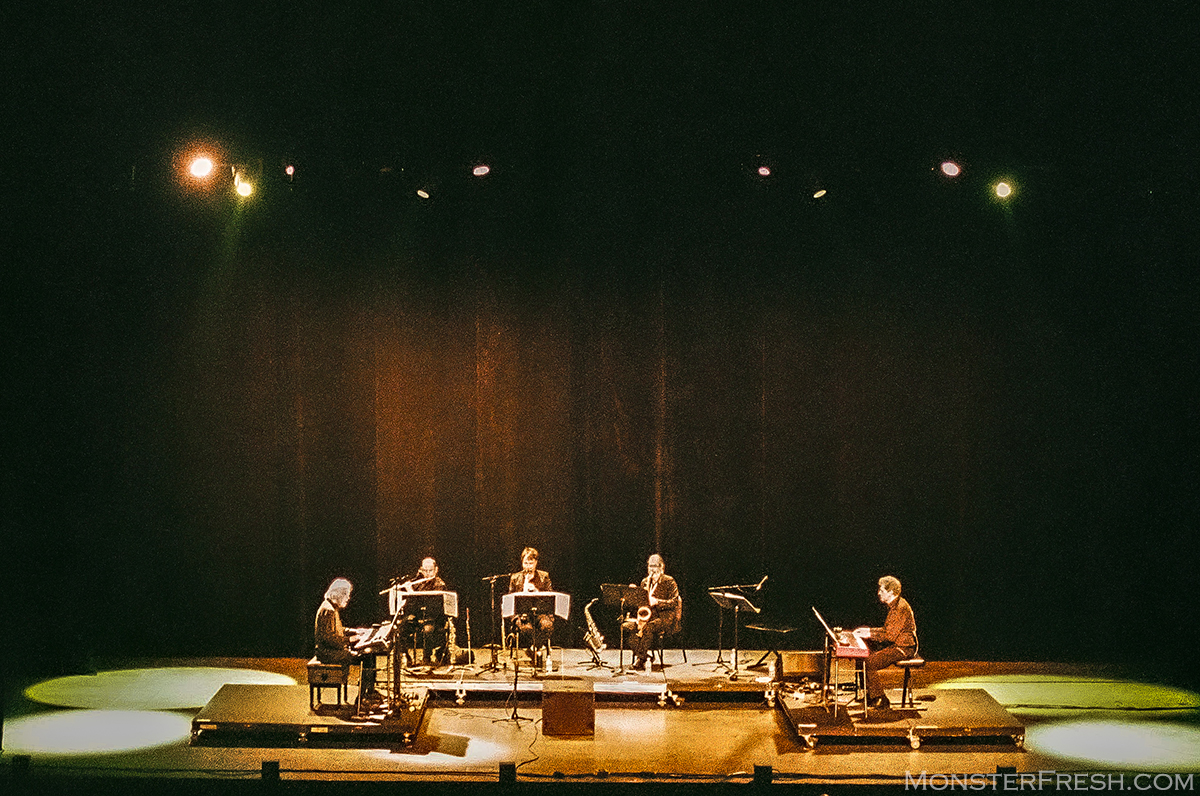
Another late night turned into another late start on Saturday. There is so much to experience beyond music, such as art shows, discussion panels, and documentary screenings. I want to believe I can hit them all, but it’s just not realistic. We did what we could and got downtown in time to catch some of The Philip Glass Ensemble at Tennessee Theatre.
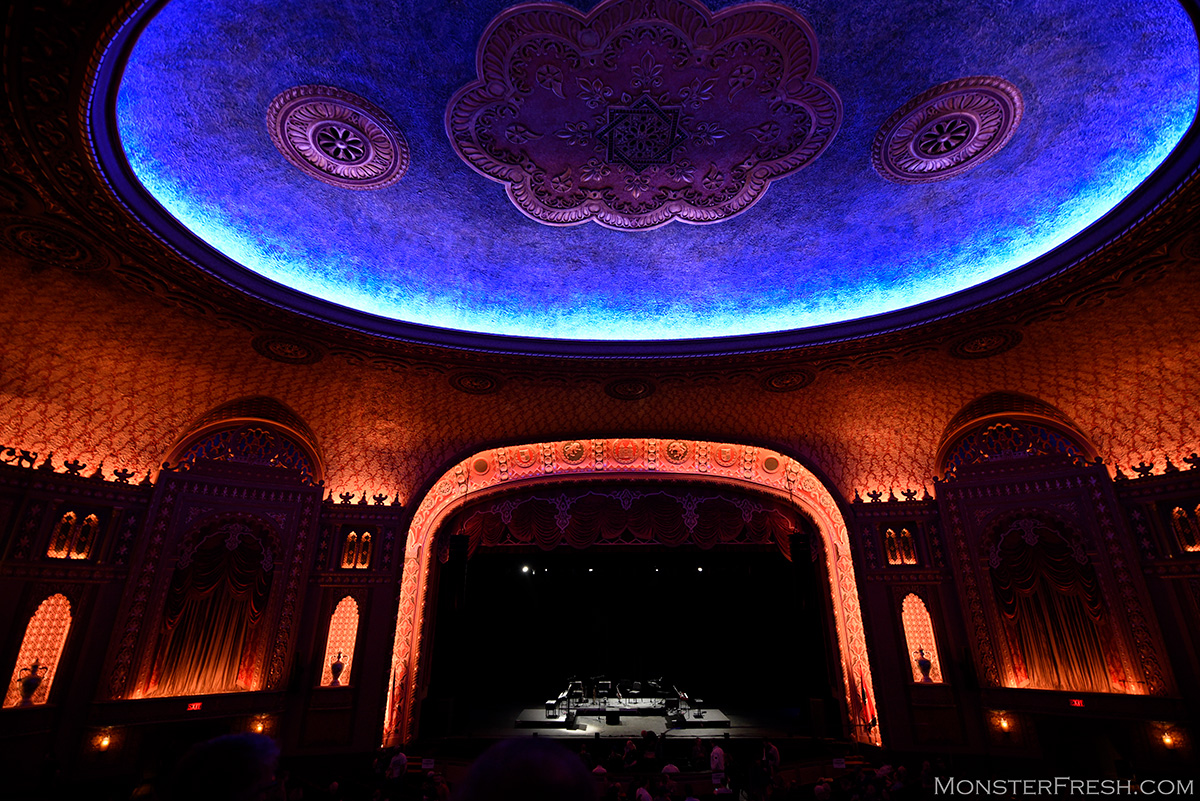
Opened in 1928, Tennessee Theatre is on the National Register of Historic Places and is home to the Knoxville Opera and Symphony Orchestra. With a listed capacity of 1,645, it’s easily the biggest Big Ears venue behind the Civic Auditorium and much more aesthetically pleasing. I don’t know enough about architecture or design to get technical about stylistic references, but it’s an incredibly ornate and visually arresting space with a sprawling balcony and big, magnificent domed ceiling. It’s no surprise that it was once deemed “the South’s most beautiful theater.” Every bit of this place is so meticulous that it’s borderline intimidating. I had a media pass, and still half-expected to be approached by security asking how I sneaked in. It’s what I imagine our shithead president believes all of his tacky ass properties look like. It’s immaculate. I wish I’d gotten better photos, but there are plenty online. I was too concerned about disrupting the crowd by standing in the aisle and firing off clacks during the performance.
THE PHILIP GLASS ENSEMBLE
Founded by Glass in 1968, The Phillip Glass Ensemble‘s stated purpose was to “develop a performance practice to meet the unprecedented technical and artistic demands of his compositions.” Although Philip himself only personally appears during select performances, he has expressed that “The PGE represents the most authentic performance practice of [his] music in our time.” Many works, such as the groundbreaking soundtracks to Godfrey Reggio‘s Qatsi trilogy, were composed expressly for PGE. to perform. Another example is the 4hr masterwork, Music In 12 Parts, which the ensemble was presenting in full during the festival.
Due to the breadth of the piece, the entire thing wasn’t presented straight through. On Saturday, the ensemble was performing the second half of which we would only catch a portion. As insinuated, Music in 12 Parts is comprised of 12 separate segments. It’s a minimalist composition that was an early exploration in repetition for Glass. The music is both repetitive and constantly advancing, with some changes so subtle they are nearly imperceptible. The sounds gradually unfurl and evolve, layered and immersive. It’s a wondrous piece that’s meant to envelop the listener and consume them, meditative and transcendent. Unfortunately, we only got a taste of that sweet audio nectar and didn’t have the 2 hours available to detach ourselves and melt into the ether. It’s a big meal that I’d love to dedicate a day to, but we were spreading ourselves thin trying to sample as much as we could from what felt like an ever expanding smörgåsbord.
TYSHAWN SOREY, KING BRITT & FRIENDS
My friend Isaac had just flown in the night before, so he and I decided to give ourselves a moment to really take in the environment. Now that the weekend was here, downtown was much livelier with festivities taking place that had absolutely nothing to do with Big Ears. Saturday market type vibes with families. Among the bustle, you’d notice the elements of the festival intermingling without conflict. We had lunch at a shawarma shop and then grabbed a coffee, before heading toward Jackson Terminal to see Tyshawn Sorey, King Britt & Friends.
Originally built in the 1880s as a freight depot for the East Tennessee, Virginia, and Georgia Railroad, Jackson Terminal isn’t just a hip name for a venue. It’s an actual terminal and, with its long brick structure, another example of the unique character of the spaces being utilized. A door or so down, still connected to the same structure, was the Blue Note Records Pop-Up Record Shop & Festival Lounge. Introduced this year, it was created to “host a dynamic lineup of talks, panels, conversations, pop-up performances, and other surprises, including special appearances and events featuring musician, producer, and Blue Note President, Don Was.” This was the only time we would visit it. Not much was happening during that window, but it was a really nice, clean, cool space where we could relax on sofas and sip our drinks until the show started. Thanks to our fancy wristbands, we didn’t need to stress while others were lining up.
Last year, Tyshawn Sorey won a Pulitzer Prize for music after composing an “introspective saxophone concerto with a wide range of textures” titled “Adagio (For Wadada Leo Smith).” Like Wadada himself, Sorey was a heavily featured name on this year’s lineup, offering several different performances with various projects throughout the weekend. I was admittedly ignorant of his work, only discovering most of what I know now as I present it. I understood him as a drummer and bandleader, but was unaware that he is a multi-instrumentalist (trombone, piano, drums) and composer, who directs a variety of ensembles and has an increasingly prolific resume. I knew that I had to make it to at least one of his performances. I had my eye on Fieldwork, his trio with Vijay Lyer (piano) and Steve Lehman (sax) for Sunday, which ultimately wouldn’t pan out, but I’m thankful that we were able to see his team up with King Britt. We’d considered going to Beak> at the same time, but once we learned that Meshell Ndegeocello would be sitting in with Britt and Sorey, the choice was a no-brainer.
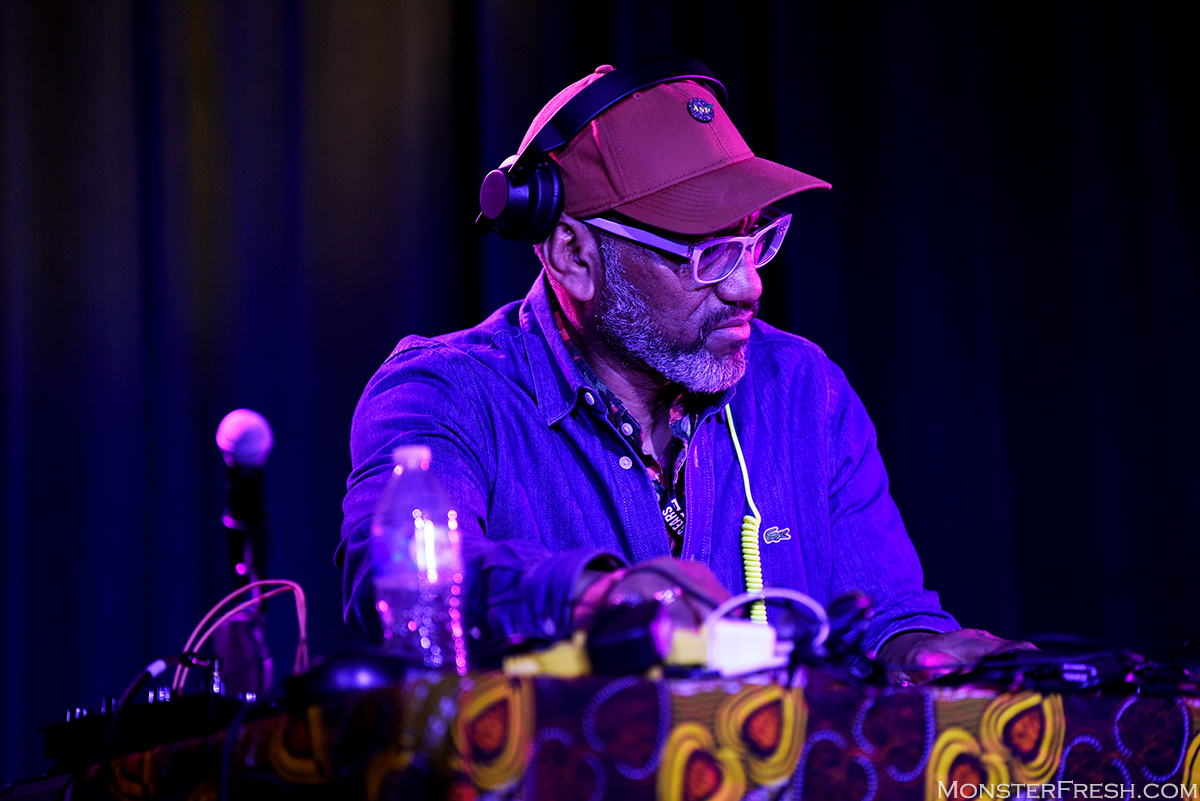
I’ve heard the name King Britt for years, always just associating him with production, hip-hop, and the DJ world. He was the original DJ for Digable Planets. I have copies of his 1998 neo-soul LP, When Funk Hits The Fan, and the 2005 reissue of Alabama outsider artist Sister Gertrude Morgan‘s “Let’s Make A Record,” which Britt presented and includes him doing a full electronic-infused remix/reimagining of the album by the self-proclaimed “Bride Of Christ.” What I didn’t know is that the Philadelphia artist is a Professor of Computer Music at UC San Diego, where he teaches the course Blacktronika: Afrofuturism in Electronic Music. Since at least as far back as 2023, King James Britt (his given name) has been curating a series of Blacktronica performances for Big Ears. His appearance with Tyshawn Sorey was one of them.
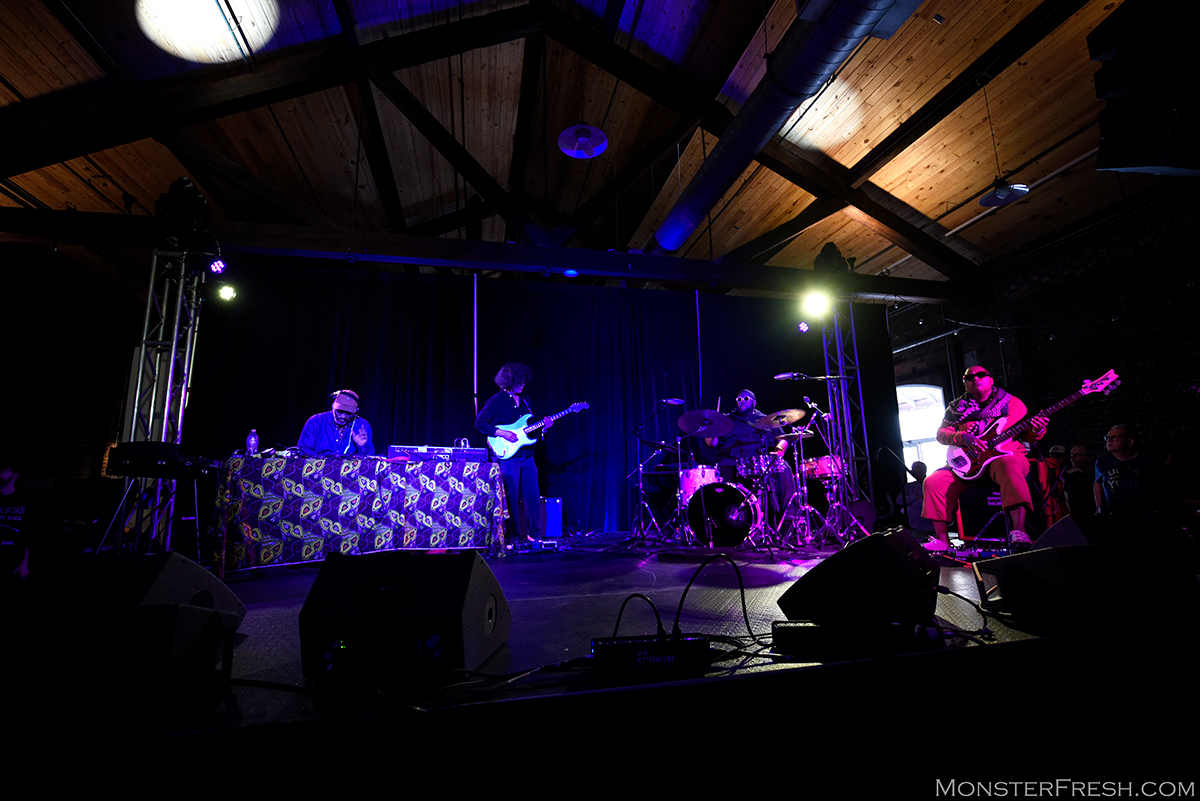
The show began as a duo, Sorey at his kit and Britt at his table of electronics. In 2021, the pair released the self-titled collaborative album Tyshawn & King. Crafted over a 2-day studio session, it’s a fascinating collection of tunes built around blooping synthesizers and complex rhythms that delves into spaced-out electro free jazz and beyond. At times it’s funky, at others funky, like misfiring cybernetics, or the stark sonic equivalent of star death. This show featured elements of that, but was more of a continuation of the approach of having no predetermined plan. They’d only ever done a handful of live shows together, and this time, they were adding a couple of strong new players into the mix.
Not long into the set, Melz (Miguel, Lizzo, Mayer Hawthorne) strolled out and posted up next to Britt, her guitar lines weaving seamlessly into the fold. She was instantly impressive, but never flashy or gimmicky. She found moments to shred brief Prince-like flurries, but they felt organic and always in service of the song. The moment she stepped her toes into the water, the color changed.
Ndegeocello entered with a similar fashion and result. The legendary bassist sat casually in a chair at the front of the stage near Sorey, effortlessly killing it like some stone-faced anime protagonist that radiates power. I remember her entering public consciousness in the 90s via the John Mellencamp duet, “Wild Night.” A bald, black woman in a white tank top and ridiculous bass skills. A highly accomplished artist, poet, and composer, she always seemed larger than life to me. Her demeanor at Jackson Terminal was almost surprisingly nonchalant. Fuck the accolades and the 13 Grammy nominations, she’s a musician in her element, not looking to draw focus, but eager to contribute to the larger whole. Her bass work was so understated, while adding dimension to everything, but when she came rumbling into focus, you knew it. King Britt mentioned how, when he told Meshell they “were going to do this,” she asked, “Can we do this together? Can we congregate? Collaborate?” To which he answered, “of course!” The real greatness of musicians like these is that they are listening to everything and expanding the totality of the sound, not looking to be overbearing, separate, or elevate themselves above it.
Based on the research I’ve done, this performance perfectly encapsulated both Britt and Sorey‘s perspectives on music. Both are noted fans of John Cage, and I’ve found examples of Tyshawn referencing the late music pioneer/theorist’s concept of the “totality of sound.” Sorey has even veered away from solos in some of his ensemble work and discusses the blurring of lines between genres, as well as between the concept of improvisation and composition. Like The Squanderers, he prefers the term “spontaneous composition” to improv or experimentalism, stating that that sort of terminology denotes a lack of rigor or intentionality. These artists are serious about their crafts; they aren’t simply fucking about.
King Britt once participated in one of Amoeba‘s “What’s In My Bag?” videos and, along with John Cage, he selected titles from fellow Big Ears performers Laraaji and William Basinski. He also chose a record by Sun Ra, whom his mother knew and would take him to spend time at the Sun Ra house in Philadelphia as a child. Another selection was Talk Talk‘s Spirit Of Eden, often credited with laying the groundwork for post-rock. Watching this Jackson Terminal show, it made me think of the loose definition of that pseudo-genre being the use of traditional rock instruments to create spatial, primarily instrumental music, void of traditional rock song structures. At times, that may have been what we witnessed, and if these were all white performers, maybe that label would be suggested more. In all honesty, I’m not sure how to categorize this collaboration, and I don’t really desire to. There was jazz and elements of rock guitar, beautiful passages and crescendos, even a little “Dark Star“-esque Grateful Dead in the shimmering synth. Most importantly, it all worked and proves they belong together. It also proves the importance of the Blacktronica component at Big Ears; it’s less of a niche addition and something all-encompassing that is a brilliant representation of the ethos.
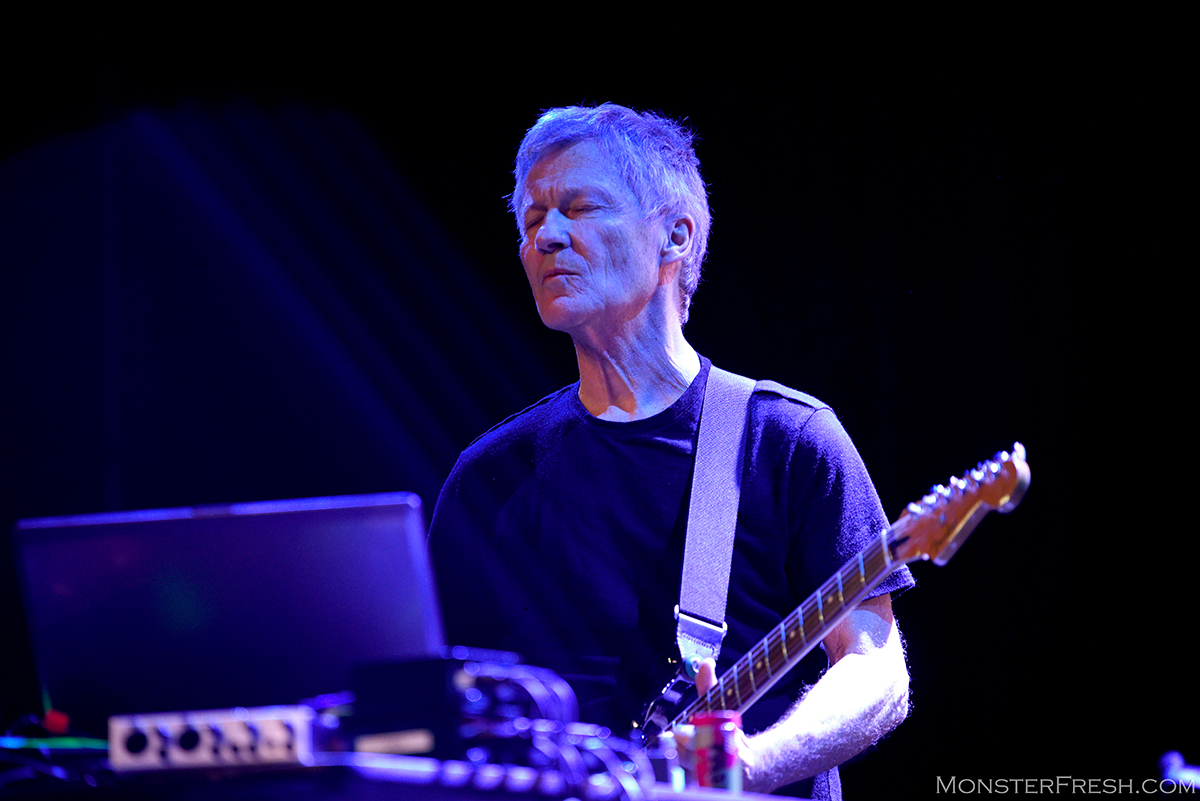
MICHAEL ROTHER
We caught the end of Beak> at The Mill & Mine and then kicked it around the area until Michael Rother took the stage. There were certain acts that I wasn’t willing to miss, and the German electronic music pioneer was one of them. He’d performed in Seattle the night before I left, but I had my flight in the morning. I’d considered trying to make it, anyway, but it wasn’t realistic. I had never seen Rother live before and, if I missed him now, I didn’t know if I’d ever have another chance to make it happen.
Michael Rother is a living legend. If his name isn’t familiar to you, some of his projects and collaborators should be. The multi-instrumentalist played guitar in an early incarnation of KRAFTWERK, before he and partner Klaus Dinger left Florian Schneider to form the duo NEU! in 1971. Michael‘s brilliant, minimalist guitar and synth work alongside Dinger‘s trademark propulsive motorik drum style helped define what many think of when they hear the terms Krautrock and Kosmische Musik. As NEU! began to dissolve, Rother started collaborating with peers, Dieter Moebius and Hans-Joachim Roedelius of the band Cluster. He co-produced their classic Zuckerzeit LP and united with them to form the supergroup Harmonia, who would go on to become a key inspiration in the development of ambient music. Brian Eno referred to Harmonia as “the world’s most important rock group” and visited their compound to play with the trio in 1976. The tapes from that recording session would be uncovered and released as the album Tracks & Traces more than two decades later. That visit took place right as Eno was about to start work on Bowie‘s Berlin trilogy, which was heavily inspired by the German music scene. The Thin White Duke even asked Rother to play guitar on the album Heroes, but something happened behind the scenes that resulted in his management shutting it down. It should be noted that “Hero” is also the title of a NEU! song that Bowie had expressed affection for.
Rother has had a long and highly influential career, but for this tour, he is focusing on the music of NEU! and Harmonia. From my understanding, his solo albums were much more successful overseas than his early 1970s works, which were considered commercial failures. When you’re ahead of your time, you have to wait for time to catch up, and in the case of NEU! that’s true in more ways than one. Because their recordings relied heavily on overdubs, NEU! was never much of a live act and didn’t do much touring. It’s somewhat ironic, considering that Klaus and Michael formed the project with a mission to harness more of the heavy-driven elements they achieved while playing shows with Kraftwerk. One thing that enticed Rother about Harmonia was that they thrived in a live environment. Being able to experience the music of these beloved projects 50 years later is a gift, now that he finally has the band to pull it off.
Michael held his guitar behind a long table strewn with electronics and a laptop. There was a large projection screen behind him. Franz Bargmann joined with his guitar, as did Vittoria Maccabruni (vocals, electronics), an Italian producer/composer with whom Rother made a collaborative album in 2022. The most notable addition was drummer, Hans Lampe. Hans initially entered the picture in 1973, when he assisted famed krautrock producer, Conny Plank, as an engineer on the album NEU! 2. In trying to expand the band to play live shows, Rother attempted to recruit the guys from Cluster, which ultimately led to him just splitting to work with them instead. Similarly, Dinger sought to bring his brother and Lampe on board to play drums, as he wanted to shift to guitar. Those three ultimately formed the project La Düsseldorf and went their separate ways, but they did appear with Rother on NEU! 75, which was essentially recorded out of contractual obligations. Years later, Rother and Lampe forged a relationship of their own and, in 2012, they performed as a trio with Dieter Moebius, who died 3 years later. Rother couldn’t have selected a more ideal candidate than Hans to help him revisit the NEU! and Harmonia catalogs.
The performance was almost too surreal to process. Rother is a stoic fellow of few words, and his crew was direct and precise in their delivery. At 77, Lampe remains a machine behind his electronic kit. Meanwhile, the frontman embodies the music he composes, at once mechanical and direct, yet airy, expansive, and affecting. He would focus intently on his laptop and then return to his guitar to lay pastoral-psych guitar lines and driving riffs over that sweet churning motorik beat. They played such NEU! tunes as “Hallogallo” and “Negativland” interspersed with Harmonia numbers like “Deluxe (Immer Weiter)” and the infectious, hypercolor joyride that is “Dino.” The band was locked in, bobbing their heads along to the beat in unison with the crowd as they drove us down a futuristic motorway with detours through the past.
Rother is the type of artist that is so exciting for me to see that it’s difficult to stay in the moment. He’s spoken about what an obstacle it is for him to tour the US, so it’s not something that happens very often. Plus, at the age of 74, it’s a miracle that he remains so youthful. Dinger is gone. Florian is gone. Moebius is gone. It was hard not to get in my head and consider how lucky we were that this could happen at all. Even then, the music was trance-inducing.
And then there was that projector screen flashing imagery throughout the set. It’s such a simple, basic prop, yet such a vital one. Old photos of Michael Rother and his former bandmates appeared, injecting a surprisingly emotional component into the show. The screen zoomed in tight on a large picture of Klaus Dinger‘s rugged face — unruly Rasputin beard, a reckless mane, and intense, deep-set eyes. Rother has been clear that the two of them were never friends, but they shared a mutual respect and unspoken understanding of what the other brought to the table. Despite any conflicts or disagreements they may have had in life, they left an impact on one another and a legacy that can never be erased. It was a beautiful tribute.
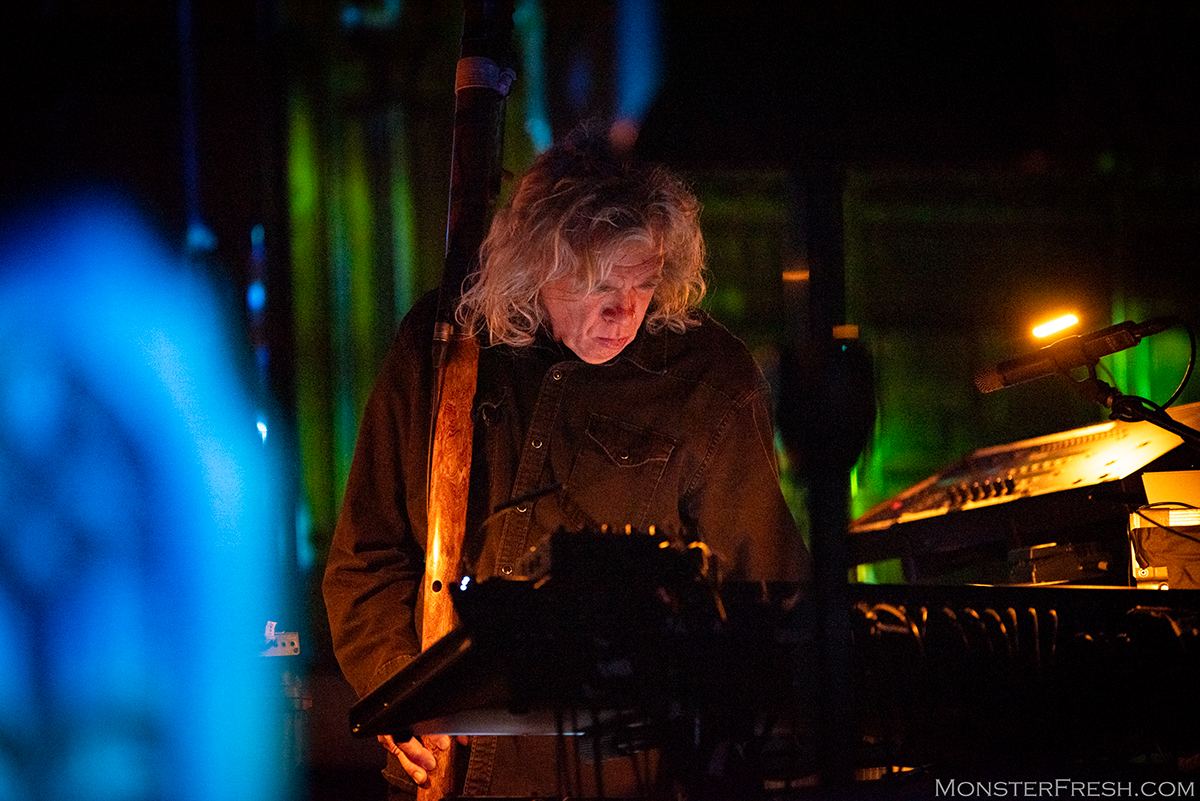
STEVE ROACH
Next on our list was SML at The Standard, but the line was a bit long, and some of our friends only had standard wristbands (pun-intended). Rather than wait, we decided to jump on a trolley to see ambient/electronic pioneer, Steve Roach, perform in a cathedral. You know a festival lineup is insane when something like this is your backup.
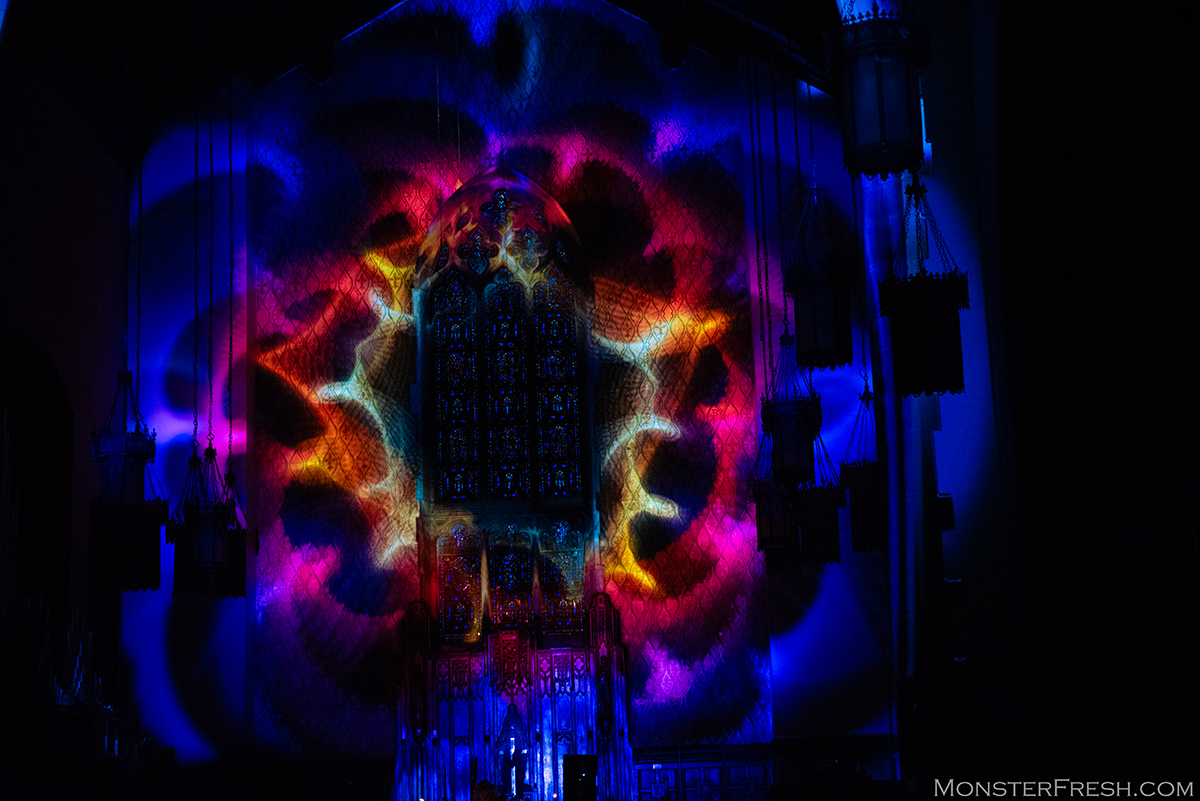
We entered Church Street United Methodist Church and quietly shifted into the wooden pews, trying not to disrupt the environment. We were 5 deep at this point. The only reason Roach wasn’t a higher priority is that at least one of us had seen him recently, and he had a couple of these 2hr performances scheduled throughout the weekend. His sets were part of an event series by the Age Of Reflections collective, who specialize in 3D projection-mapping. They would be using it to illuminate a selection of ambient artists over a 3-day period. More specifically, they were performing “site-specific lighting that grows in intensity during the day. At sunset, they’ll shift deeper into the sublime with projection-mapped lighting.“
The way the shuttle dropped us off gave the impression that the cathedral was in a somewhat isolated location away from everything else. It was dark inside, but I could make out the silhouette of Steve Roach surrounded by synths and other less orthodox instrumentation. The ceiling reached up to the heavens, and there was an immaculate stained-glass window behind the electronic visionary. Sound undulated while abstract purples, teal, and amber projections shifted in and out of each other like a kaleidoscope. Engulfed by this morphing nebula, Roach would purposefully turn to a synth, then to a didgeridoo, allowing the sounds to fuse and resonate through the room. Textures rippled out like sonar and through my entire being on impact. It didn’t feel like a show as much as walking in on a ritual that wasn’t intended for onlookers. A ritual that was too far gone for him to care, because it was too late to stop it. And why would we? It was hypnotic. Why would we….?
Oh, right! Because we’re at a music festival.
Much like with The Phillip Glass Ensemble, I LOVE that this is on the schedule, but, for the benefit of my mission, I’m forced to pull myself out of the quicksand or risk losing half my day stuck in a hypnotic netherworld.
WAXAHATCHEE
As the rest of my group funneled into the Tennessee Theatre for Dahka Brakha, I split off solo toward the Civic Auditorium. I’ve seen the Ukrainian folk-quartet before, and I wanted to be there in time for Waxahatchee.
On paper, Waxahatchee would seem like one of the bigger draws on most festival lineups. Her 2024 album, Tiger’s Blood, was a critical success, and the fact that she was booked for a headlining spot in the largest room available should reinforce that Big Ears agrees with that assessment. Still, I didn’t find this to be a show that most people were talking about or making space for. Perhaps, when you’re chasing the unorthodox, rare, experimental, and unusual, a contemporary singer/songwriter, no matter how talented, might feel like too safe an option; something you can see anytime, wherever.
The turnout was pretty solid, but here’s a little tip for the Civic Auditorium. The venue reserves several rows up front for VIP ticket holders, and they always hold too much. As showtime approaches, they will generally open seats to anyone who wants to move up. If you’re interested and ready to do that, you can usually find something close. I grabbed my equipment and slid into a spot in the orchestra pit.
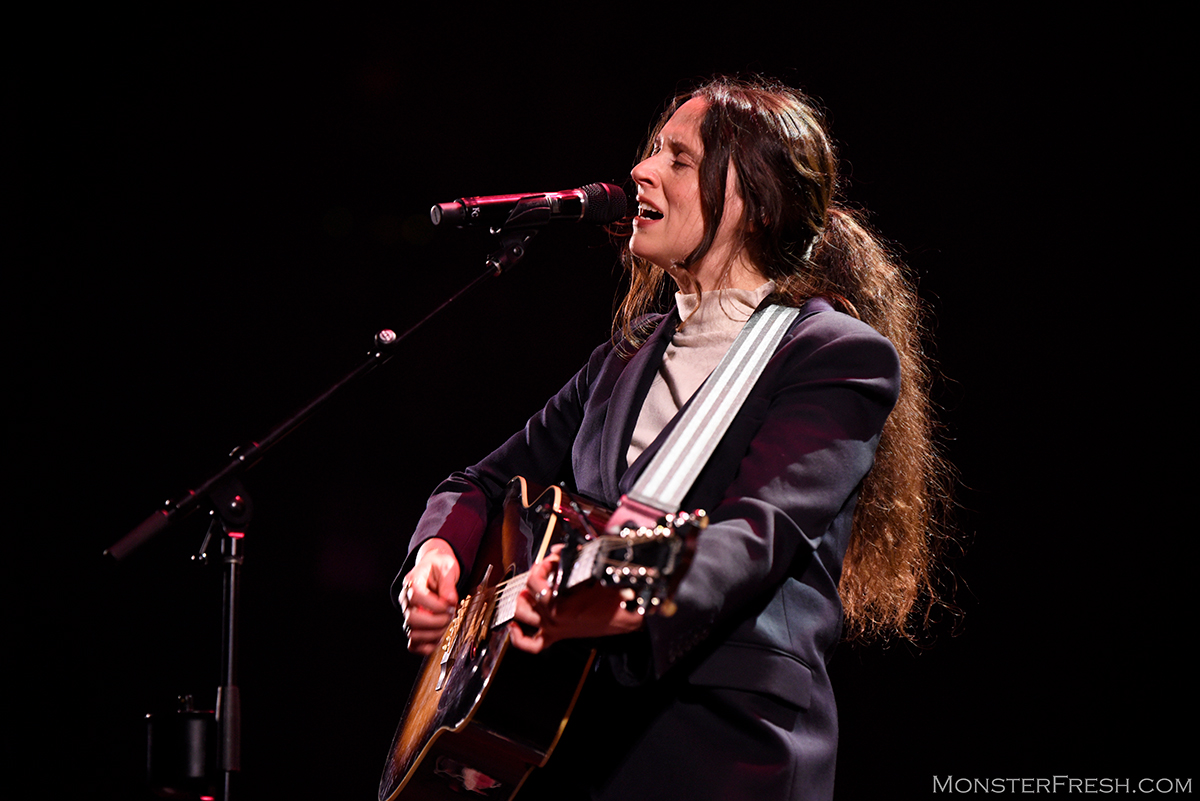
Katie Crutchfield was accompanied by only a single backing musician when she emerged. She took center stage as he positioned himself further back to her left. Sideman, Cole Berggren sat at a Nord Electro 5D with a couple of guitars on stands behind him. Crutchfield had her acoustic. She was wearing a turtleneck and a blazer with wide-leg jeans. Her hair was loosely restrained in a thick ponytail that reached the small of her back. She was an island on that massive auditorium stage. When so many artists are going bigger, forming collaborations, and bringing ensembles to the festival, the Birmingham native took the opposite route.
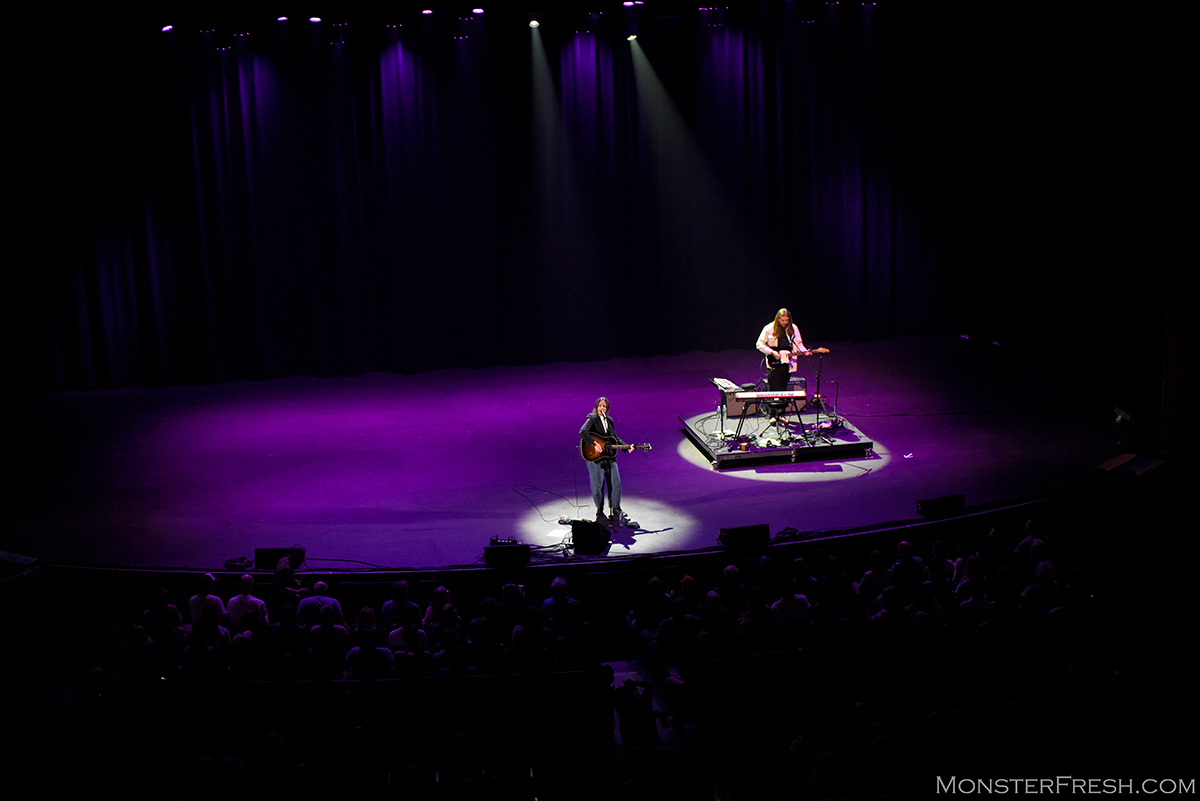
Crutchfield commented on her accompaniment, stating that she doesn’t like to rehearse, and Cole has the miraculous ability to make her sound good without it. Together, they performed an intimate, stripped-down set focusing on her more recent work. Tiger’s Blood was well represented, including the hugely popular duet with MJ Lenderman, “Right Back To It,” featuring Berggren on banjo and harmonies. Also in the mix was a decent selection of songs from 2020‘s St Cloud LP, such as “Lilacs,” “The Eye,” and “Ruby Falls.” Additionally, she performed the unreleased track, “Next To Me,” which is set to appear as a 7-inch B-Side this Record Store Day.
Crutchfield‘s progression as an artist is an interesting one to track. In high school, she formed the indie-punk outfit, P.S. Elliot, with her twin sister Allison, creating invigorating tunes with genuine heart and energy that resonate to this day. The first Waxahatchee album, American Weekend, arrived in 2012 as a hissing, lo-fi solo acoustic effort recorded in her bedroom. Think Beck‘s One Foot In The Grave with even lower production value. The following year came Cerulean Salt. Still lo-fi, it had slightly more polished production, electric guitar, and a healthy scoop of Kim Deal in the vocals. Ivy Trip (2015) saw a bigger indie fuzz sound with even more confident production and songwriting, which only increased with the big choruses on Out In The Storm (2017). For 2018‘s Great Thunder EP, she pulled back to stark, minimalist piano and vocals to deliver something reminiscent of Cat Power that showcased her warm, beautiful vocal range. It’s over the last two releases that Katie has fully settled into the Lucinda Williams style of songwriting that her work has always hinted at, and which she’s currently known for. These days, it’s all about great melodies, evocative lyrics, and strong vocals.
Katie Crutchfield has found her voice, both literally and figuratively. There’s an imperfect quality in the subtle rasp, and an earnest beauty in the power that wells from deep within her. Standing on that stage, she left no doubt that the songs are solid enough to carry themselves without any layered production or full band behind them. The songwriter didn’t phone it in by failing to assemble some grand presentation at Big Ears, she did the opposite and took a risk. Crutchfield told us that Big Ears has long been her favorite festival. She’s attended in the past, always hoping to perform there someday. This gig truly meant something to her, and how she chose to present herself wasn’t an afterthought. Knoxville Civic Auditorium can be a terrifying room, especially for a performance that you’ve imagined in your mind for years. Crutchfield made the bold choice to step onto that stage raw, ungaurded and honest. It was everything she needed to captivate the crowd, her voice reaching the furthest corners of the auditorium.
Some people may have wanted or expected the sound of a full band. Some fans may be disappointed that Katie isn’t choosing to revisit her early material. I can understand both takes to a degree. That early work has a very specific feel and purity to it that hits differently. But when I evaluate what was so powerful about the lo-fi Waxahatchee, and even the irreverent P.S. Elliot material, it’s how palpable the desire and demand to be heard was. At the time much of it was written, Crutchfield was living in places like New York and Philadelphia, distancing herself from the Southern roots that she now more openly embraces. Who’s to speculate how connected the Grammy Nominee even feels to that past? As a society, we need to have more support for the concept of artists evolving, as Crutchfield continues to do. She’s a woman with confidence and power who’s at the top of her game. She has years of sobriety under her belt and has shed a thousand micro versions of herself on the path to get here. If the concern is that the early spark that was driving her has somehow been dampened, I propose that walking out onto that stage in that massive auditorium, knowing all eyes would be on her, is about the most punk shit she could have done.
Walking back to The Mill & Mine, I wound up on Central St, passing rows of bars and an active nightlife. It was the first time I’d encountered this in Knoxville. Just a couple of blocks over, it was still a fairly reserved scene, but here it was loud, chaotic, and crowded with drunken college kids and convertibles rolling through the street at a glacial pace with the tops down and their speakers blaring. This was the reminder that I needed of where I was. This is a college town of wild keggers and too much cologne, not year-round jazzville. The upside is that, since we were in Tennessee, these white kids in dress shirts were bumpin’ shit like Three 6 Mafia out of their whips, rather than Drake out of Teslas. The truth of the matter is that I did kind of fuck with that.
We met back up at The Mill & Mine to watch Vernon Reid shred the fuck out of his guitar in his jazz-funk trio Free Form Funky Freqs. From there, we headed to The Standard to try and squeeze into see Water Damage. Since it was the only thing on the schedule at that hour, the line was bananas. We finished the night back at the karaoke bar until we were ready to bag things up.
As we waited for our ride out front, a trio of men walked past us. One of them noticed the karaoke bar. He was a youngish black man, perhaps early 30s, and he had joyful energy overflowing from him. He laughed to his friends that he was going in for a song, before sprinting away from them and down the steps to the basement lounge. I looked to his friends and noticed what a ragtag crew they had. There was a white man who looked only slightly older than him, but had more of a handiman/Fox Racing enthusiast vibe. As the first man ran back up to join is friends, I noticed that the third person in their crew was none other than Steve Roach, a 70-year-old emotionless sorcerer hovering among them and dead-on resembling Vigo The Carpathian. He turned with his familiar and the hyperactive meal they’d wrangled, disappearing into the night en route to his cathedral lair. Or… probably just headed back to their own rental to watch TV or something. I’m just speculating.