ALL EARS: BIG EARS 2025 [DAY 4]
The final intallment in our extensive coverage of the Knoxville music and art wraps things up with Laraaji in a cathedral, Edsel Axle, Wadada Leo Smith, mum, and Explosions in the sky
I hoped to catch Lonnie Holley at 1 pm, but it was not to be. It was the final day, and we were moving slower than ever. Plus, it was raining. We decided to shoot for Laraaji at St. John’s Cathedral. Our friend Dan dropped us off downtown on his way to pick up his daughter, whom he’d been bringing to the festival. We couldn’t find the entrance, and a vagrant was sleeping out front. This was not the right place, but Dan was already long gone. It turns out there’s more than one St John’s, and we were on the opposite side of town.
We walked through the city in the rain, intermittently, discussing whether we should keep moving or wait for the trolley/shuttle whenever we passed by a stop. I was ready to bag it and step into the Tennessee Theatre for Tindersticks. I would have gone either way, but Isaac was set on Laraaji, so we kept it moving. Eventually, we cut through a parking lot, found our way around the building, and walked up to the entrance. There was a line, but it moved quickly. After a brief wait, we were ushered through the door.
LARAAJI
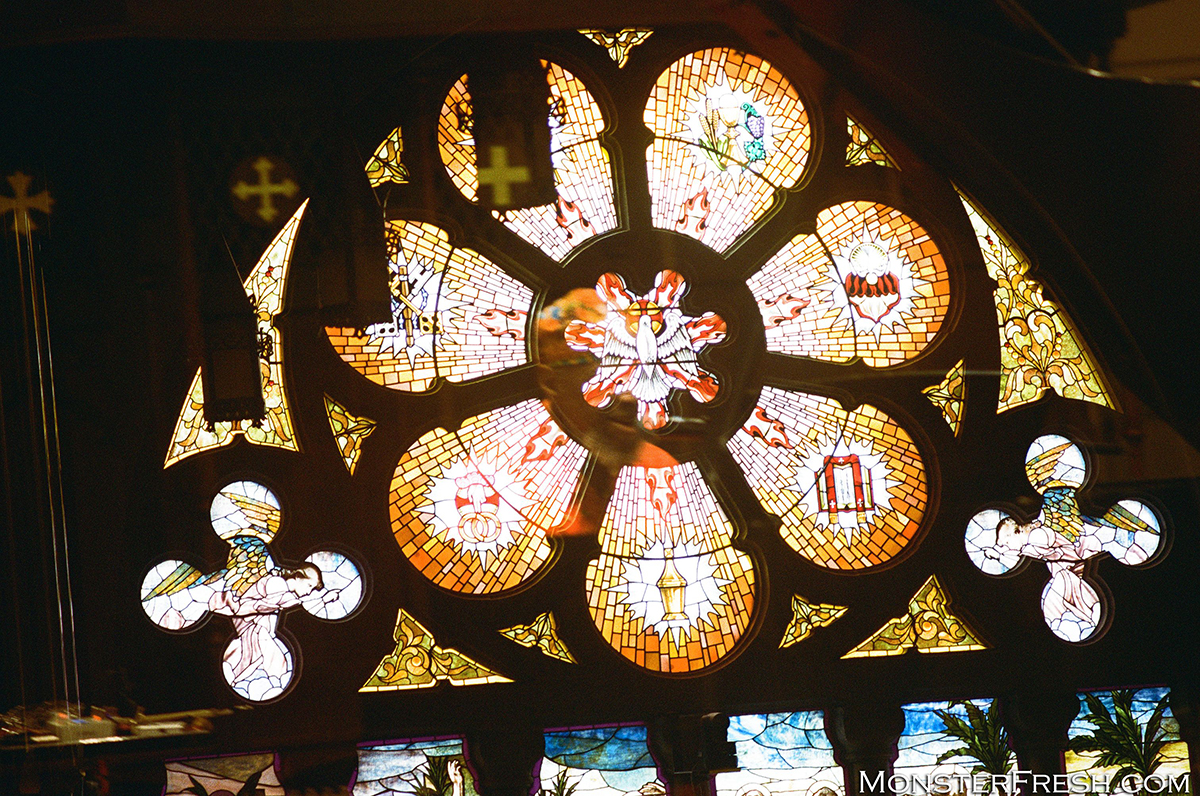
We were in church on Sunday. Nick from Sylvan Esso and the Psychic Hotline label was seated in one of the pews. St John’s Episcopal Cathedral (the correct location) is an exquisite structure with ornate crosses on the walls and meticulously detailed stained-glass depictions of saints and religious iconography everywhere. Perhaps it was simply the time of day and/or nature of the performer, but this scene was in stark contrast to the ominous dungeon of the occult vibes that we encountered during Steve Roach the previous night. Two ambient music legends in two different cathedrals, a mere 3-5 minute walk from one another, offering two decidedly different experiences.
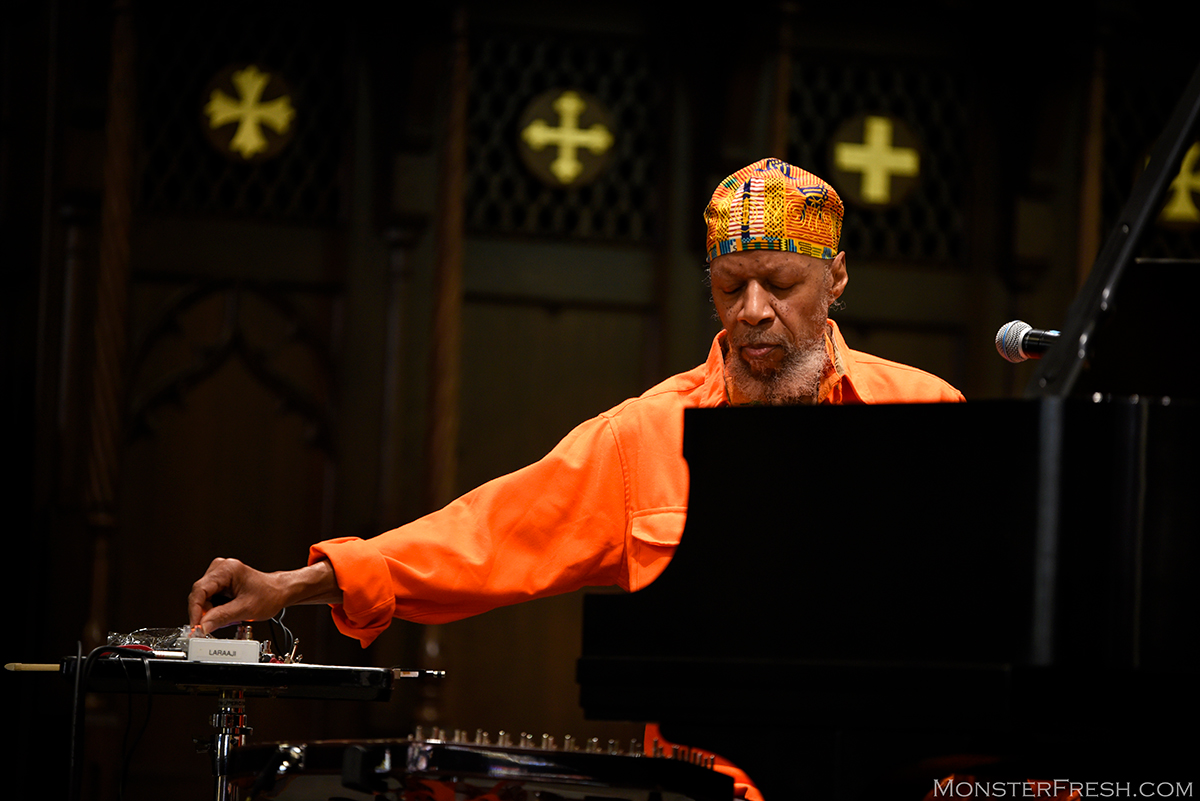
As could be expected, Laraaji was dressed entirely in orange right down to his socks and sneakers. He sat at a piano in the center of the chancel (altar platform), a mosaic of Jesus on the wall beyond him. A zither and a small table with only a few electronics were positioned close to his right. On the walls at either side were engraved twin cases containing pipes that extended to the ceiling. They belonged to a pipe organ that I wish Laraaji had access to. He sat beneath an immaculate dome surrounded by gold, fleur-de-lis, and floor-length candesticks. I know that it was raining and overcast, but my memory inside that church doesn’t align with that reality. Perhaps it was all those windows, but natural sunlight filled and illuminated the cathedral. Draped in tangerine, Laraaji, with his radiating smile, was a light source of his own.
The story people like to tell is how Laraaji was performing in Washington Square Park when he was “discovered” by Brian Eno and invited to make the record, Ambient 3: Day of Radiance. More importantly, the man born Edward Larry Gordon was already a trained musician who studied composition and piano at Howard University. In fact, Ambient 3 wasn’t even his first recording. Since then, he’s gone on to release dozens of albums and leave an immeasurable impact on the music world. A hugely influential figure, the multi-instrumentalist has explored and laid the groundwork for ambient and meditative music while fusing electronics and Eastern mysticism. Another octogenarian with multiple slots on the bill, Laraaji, is a living legend who is right at home during Big Ears. This wasn’t the first year he’s played the festival.
The man in orange is all about joy. At times, he would joke and laugh with the crowd between songs. He plays beautiful, transcendent music, but his attitude is light because his soul is light, and that’s where he pulls from. Perhaps, if more people viewed church as a place of shared humanity and celebration of life, we would be more inclined to go. I walked in believing that we had borrowed the space for an ulterior purpose other than it was erected for. Instead, I encountered a man who has made it his purpose to remind us what purpose truly means.
EDSEL AXLE
One of our favorite releases from last year was Bite Down by North Carolina songwriter, Rosali Middleman. For an album that is so immediately inviting, Bite Down is deceptively complex. There are grounded Americana elements cut by sweet soaring vocals and fearless, yet subtle guitar work. These are beautifully crafted tunes that slowly unveil themselves to be more each time you hear them. A chorus or melody might have been the first hook, but listen to the depth of the lyrics. Catch that melting riff, shriek, or evaporating guitar line that wafts through, stings, and dissipates like ether. The songs rumble, come alive, shift, and plant their feet; limbs buoy, or wrap the torso like vines. There are layers to it.
From what I’ve seen, the critical response to Bite Down has been consistently positive. I wonder, then, why it hasn’t had the reach of similarly strong efforts from last year, like Manning Fireworks by fellow North Carolinian, MJ Lenderman. Both are fueled by impressive songwriting and marbled with southern-tinged indie-rock, thanks in part to Rosali‘s continued collaboration with Nebraska‘s David Nance and Mowed Sound as her backing band. Both are growers that show all the signs of longevity. It can be difficult to answer why MJ is playing sold-out theaters, while Rosali is so often relegated to an opening act, but the reason is NOT talent or ability. She has both in spades.
Back in October, I had the opportunity to see Rosali open for Mdou Moctar in Seattle, and her live show is a sight to behold. It was captivating; the type of concert where you leave your body and are absorbed into the gel-filtered smoke of the nightclub atmosphere. Her voice is undeniable, but guitarist James Schroeder‘s contributions are so uniquely engaging that the frontwoman’s own chops are overlooked and often underepresented. Fortunately, her lesser-known project, Edsel Axle, is built exclusively around solo electric guitar. More importantly, she was bringing it to Big Ears.
The Edsel Axle show was at Boyd’s Jig & Reel. The Scottish bar regularly informs those waiting in line that they’re welcome to come inside to eat or get a drink, claiming that, although the space with the stage is limited and you won’t be able to see anything, you should still be able to hear the music from the restaurant/bar area. I don’t know if that’s true or not, but we decided to show up early and dine there. That way, we would already be inside and could slip right into the show once they began admitting people.
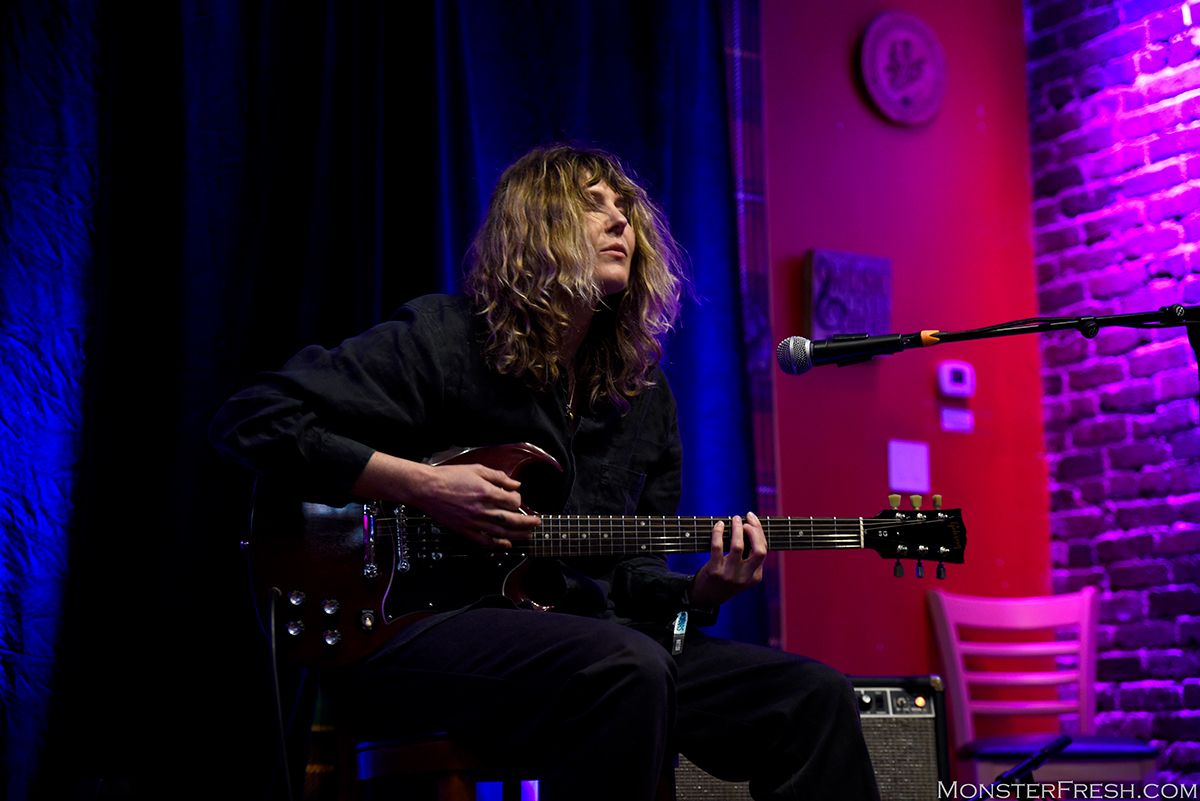
Rosali sat on a wooden chair holding a burgundy Gibson SG. She was dressed simply, and for comfort — pants, a long-sleeve button-up shirt, and socks. No shoes. There was a pedal board at her feet. The monochromaticism of her faded-black look was only one of the parallels between her and Laraaji. This was a collective experience focused on gentle ethereal sound. Head down or tilted back with her eyes closed, Middleton was locked in and zoning. Edsel Axle is a delicate alchemy of loops and tone, with the guitarist laying imperfectly precise phrasing over sonar and whale calls. Guitar over guitar over guitar. Less is more… and then more… and… perhaps just a little more. What are these basic tools capable of in the hands of one woman? This was a demonstration of versatility for both the artist and their instrument of choice.
Another example of “spontaneous composition” at the festival, Middleman offered insight into her creative process in real time. Guitar lines are crafted as they come and immediately dismissed to shimmer and dissolve. Sometimes, she would sample and loop her voice, working the occasional “ooooh” into the other layers. Everything is precious, because nothing is. A heron claw dips into otherwise placid water as it ripples from a droning amplifier. It’s a game of tension and release, discipline and restraint. Sometimes it gets loose and then pulls back, free-falls, and catches the wind like a sugarglider. Edsel Axle is a hybrid of the urgent, buzzing delivery of Neil Young‘s Dead Man soundtrack and the firm, yet contemplative fragility of the Dirty Three.
I loved her sole Edsel Axle effort, Variable Happiness, but I’m not sure that I ever knew it was constructed on the fly and recorded directly to 4-track. With that album, we witness the power and intimacy of Rosali‘s electric guitar work isolated and uninhibited. In person, those qualities are only amplified. I also wasn’t aware that her Edsel Axle performances have been so limited. This was only Middelman’s 4th time bringing this project to the public, and she was very open about her appreciation of us being there to share that experience. It’s a very personal and vulnerable display without the benefit of her undeniable voice and songwriting to shield her. The fact that she trusted Big Ears as a platform to put herself out there says a lot about the festival.
After the set, I purchased a vinyl copy of Variable Happiness, mentioning how she didn’t have any in Seattle, so I came to Knoxville to get one. I was wearing the Bite Down trucker cap I had purchased from her instead… as I do often. I’d been wearing it the whole trip. I didn’t put it on for the show or anything. Was this, paired with my bad joke, giving off stalker vibes? No time to concern myself with that, we have places to be.
Before we left, Rosali mentioned she would be returning later for a last-minute Edsel Axle collab with Rich Ruth and others. The energy for that was more relaxed without the weight of the entire show resting solely on her shoulders. I feel optimistic that there will be more Edsel Axle performances in the future. I actually pitched that idea to Pickathon, and they booked Rosali for this year’s lineup. Whether she adds an instrumental set or strictly performs straight-ahead Rosali shows on the farm, I’m excited to see her again in August.
WADADA LEO SMITH
We were walking down near the Bijou Theater when I recognized Deerhoof‘s Greg Saunier coming toward us holding a cymbal bag. Greg is extremely nice, so he stopped right in the middle of the sidewalk and had a brief conversation with me, despite the fact that it was still drizzling and he’d clearly been hustling to some destination. He said that he was on his way to The Mill & Mine early in preparation for a performance with Wadada Leo Smith later that day. I told him I’d been thinking of catching that, and he responded with, “Yeah. You’ve got to.” His tone implied it was the obvious choice. What else would I be doing? Nothing, I suppose. We’d be there.
Wadada is 83 years old and still creating forward-thinking and relevant music. The avant-garde trumpeter/composer first picked up his instrument at the age of 12 and composed his first original music that same year. Over the last 7 decades, he’s had an awe-inspiring career working extensively with fellow jazz icons like Anthony Braxton, Jack DeJohnette, John Zorn, and Bobby Naughton, releasing endless albums as a bandleader, and finding a second career in teaching.
There’s a misconception that these old jazzbos had their time and then simply vanished into the ether. The last 25 years or so have proven some of Smith‘s most prolific, often wth him releasing multiple albums a year and never less than one. His influence has consistently trickled down to new generations of artists who jump at the chance to work with him. One example came in 2004, when Wadada collaborated with UK electronic duo, Springheel Jack, with whom he reunited for a second album in 2018. This isn’t the first time he’s worked with Greg, either. Back in 2020, Deerhoof released a 5-track live performance they did with Smith as part of New York City’s Winter Jazzfest at Le Poisson Rouge. Wadada‘s brilliant phrasing fit like Tetris blocks into the indie-noise bands’ frenetic compositions, his horn wild and unrestrained enough to blow the pants off Howard Moon.
Leo Smith is yet another Big Ears alum who has found a home at the Knoxville festival. The composer was presenting several different projects throughout the weekend and making unscheduled sit-ins with a few more. The showcase we were witnessing featured two separate ensembles, switching midway through. The first portion was called “Radio Light” and featured an unorthodox combination of instruments. Joining Wadada was bass clarinetist, Ned Rothenberg (Mark Ribot, John Zorn, Anthony Braxton), and longtime collaborator, Min Xiao-Fen on vocals and pipa, which is an ancient 4-stringed instrument often referred to as a Chinese lute. The group was rounded out by a pair of deuling powerhouse drummers/percussionists: 85-year-old Andrew Cyrille (Cecil Taylor, Horace Tapscott, etc) and Ra-Kalam Bob Moses (Roland Kirk, Larry Coryell, Gary Burton), who clocks in at a young 77. The piece they performed was “Symphony No. 1, Fall (Ankhrasmation Music)” based around the concepts of harvest and nourishment related to its seasonal namesake. The symphony is constructed around “Ankhrasmation,” the musical language Smith developed that relies on symbols over traditional notation.
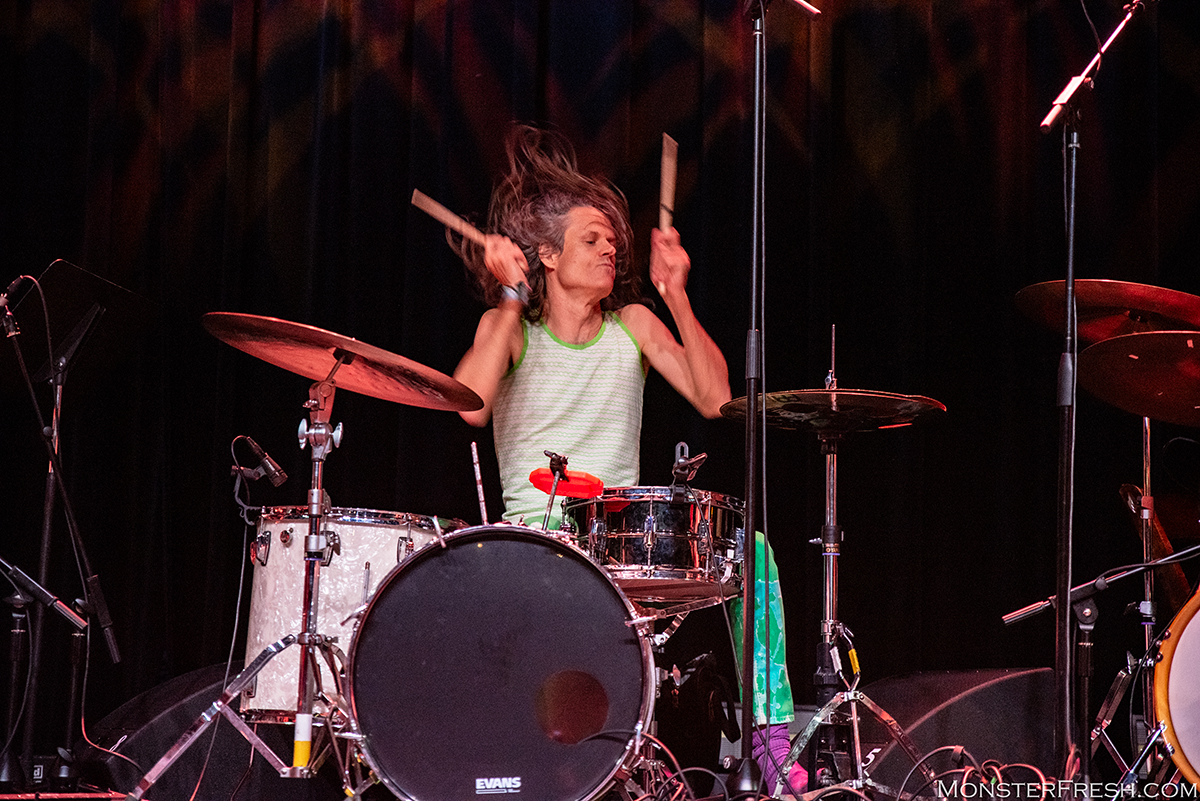
Radio light was replaced by the Orange Wave Electric ensemble, comprised of Greg Saunier (drums), Melvin Gibbs (bass), Brandon Ross (guitar), Lamar Smith (guitar), and Hardedge (electronics). This electric outfit turns things up, veering heavily into psychedelic, dark, and moody electric Miles territory. Orange Wave Electric is a supergroup that Smith assembled for the 2022 album, Fire Illuminations, which they drew from for this set. Most of the original lineup carried over to the performance except for Nels Cline and Bill Laswell, who contributed a 3rd guitar and 2nd bass to the recordings, respectively. Also absent were percussionist Mauro Refosco and drummer Pheeroan akLaff, whom Saunier replaced admirably. My favorite parts of the set were when Greg would get so wound up that he would transform into a cyclonic blur on the kit. In those moments, Wadada would casually step over to him and deliver a gentle motion suggesting he might “pull it back a little.”
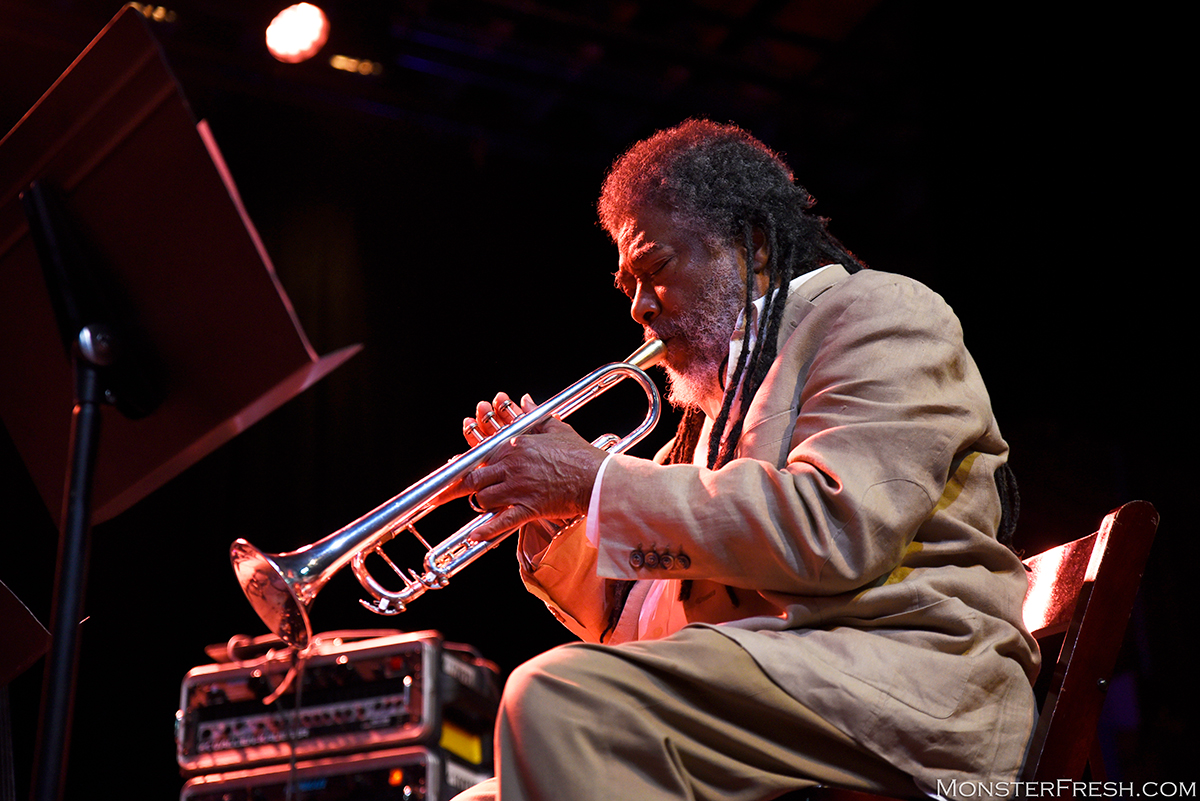
Smith is a fascinating character for many reasons, but my favorite thing about him is the way that he discusses art and music. His trumpet has a piercingly beautiful tone, but he’d likely tell you it’s not about the technique, but how it comes from his heart. His musical themes can be incredibly specific, and he speaks of deep humanitarian causes and justice, but to him everything is about culture instead of history, communication, instead of sterile music theory and rules. Death is a transition. He feels music in a way that gives it spirit, and centers everything around the human experience. A doctor may employ a lifetime of techniques to save and deliver physical human life. Wadada Leo Smith channels his immense knowledge and varied skill sets toward mending and delivering soul(s).
múm
The line outside the Bijou Theatre wasn’t moving, but we were willing to wait. I hadn’t been inside yet, and was determined to check this one off my list. The theater has lived several lives, including as a venue for Vaudeville beginning in 1908 and later transitioning into an “adult movie” house. It’s yet another gorgeous historical venue in downtown Knoxville, but at a capacity of only 700, it simply can’t handle the numbers that a Tennssee Theatre or even The Mill & Mine can accommodate.
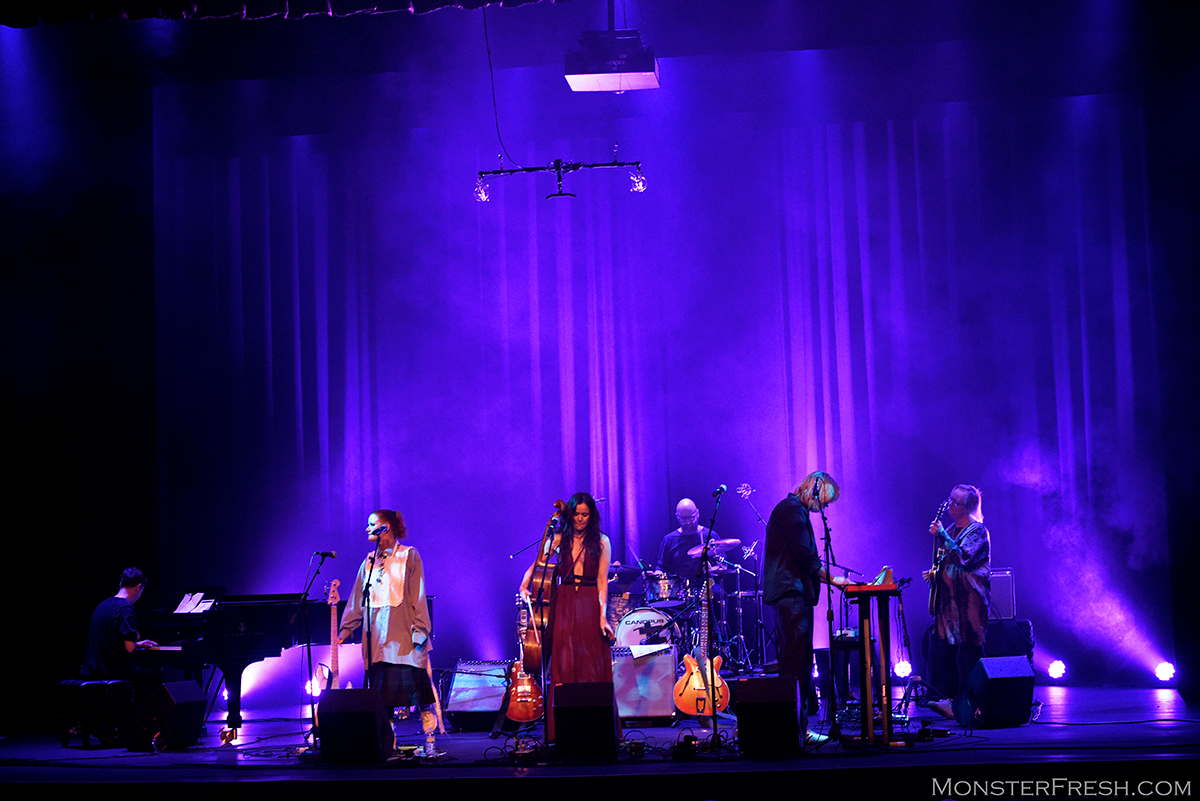
Once we made it inside, múm was already performing. The Icelandic “indietronica” band has a delicate, yet penetrating sound. There’s a quality about them that lets you know they are from Iceland, a quality that other artists from the Nordic island country like Björk and Sigur Rós also share. Perhaps it’s a connection to nature and the sea, or perhaps they are infused with myths from their homeland. Whatever it is, there’s a magic to it. Perhaps it’s just their demeanor or the way they deliver layered ethereal compositions through synths, cello, piano, guitars, and melodica. I feel so culturally insensitive to suggest it, but I’m a dumb self-hating American, and they make me feel as if I’ve awoken in some forest to discover the people of a hidden village have brought my unconscious vessel into their homes and tended to me. Their music is like cool medicine for weary souls, and I was weary as all get out.
EXPLOSIONS IN THE SKY
We only caught a portion of múm‘s show, but we heard “Green Grass Of Tunnel” and got a glimpse of the Bijou, so I felt pretty good about it. Times were overlapping, and we needed to get back to The Mill & Mine for Explosions In The Sky.
I believe there might have been one other show going down at the same time, but it was pretty clear how we were going to end this thing off. We were looking for a finale to the long weekend, so we went to Explosions In The Sky like we were supposed to. I don’t need it explained to me. It’s right in their name. This was supposed to be the fireworks.
The Texas post-rock band formed in 1999 and, if my research is accurate, they’ve managed to retain all of their original members throughout their existence. These guys haven’t been around quite as long as bands like Mogwai or Godspeed You! Black Emperor, but pretty damn close. At 26 years in the game and a respectable discography, they’ve more than paid their dues in the post-rock union. EITS are respected elder statesmen of the genre who have done their part to influence new generations.
I have a friend who loves this form of bombastic post-rock. He once referenced the band This Will Destroy You and, when I asked what they sounded like, his response was essentially, “You know.” In other words, it’s what I call crescendo rock. LOTS of build-ups. LOTS of payoffs. People who love this music know what they’re getting and are happy to get it. There are some genuinely lovely and affecting tunes, emotional compositions, and guitar lines that hit in a way that makes the listener feel alive. Compositions rise like steam and erupt, whirl into typhoons and then quell.
I’m not trying to shit on anyone for being too “formulaic,” especially when they helped define the formula. I’m not going to hit up a hot chicken spot in Nashville and then complain because their menu doesn’t offer more options. EITS has earned their acclaim, deserve what they have built, and they’re great at what they do. I’m just saying that I don’t know any of their song titles, and I don’t feel like I want to.
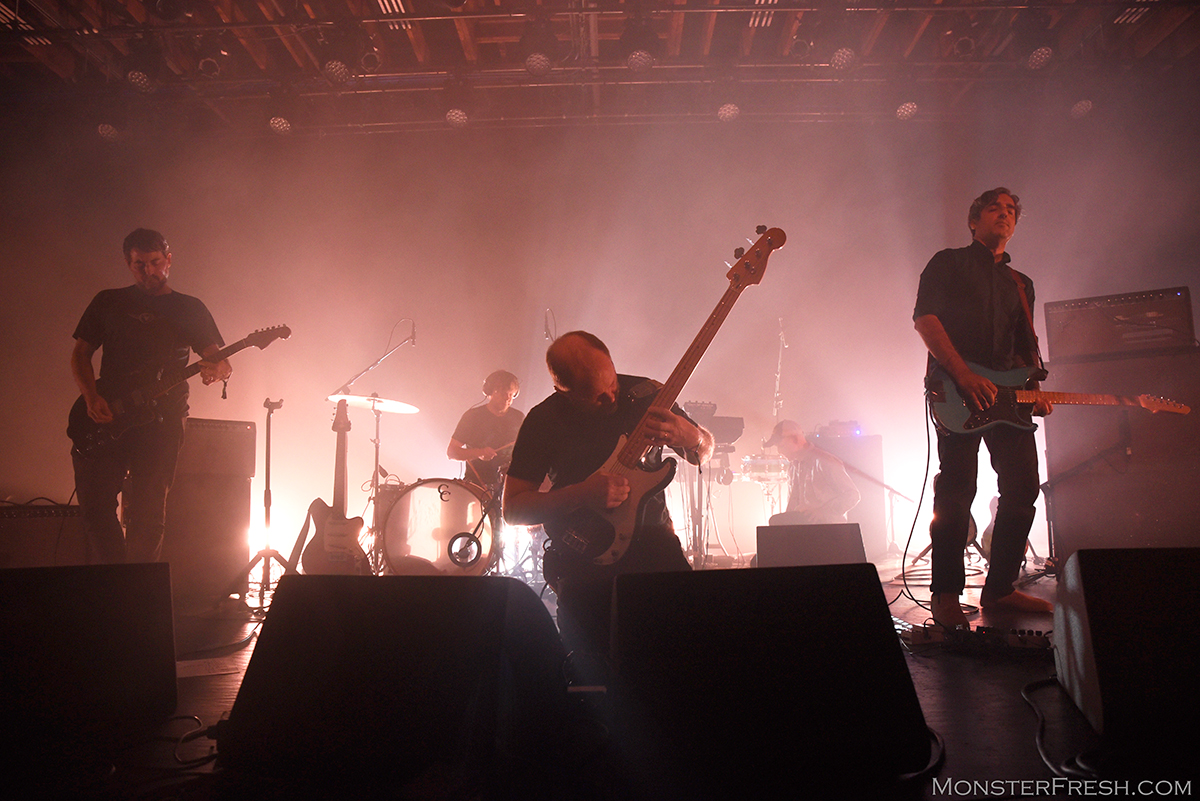
I’ve actually seen them a couple of times before — also at festivals. I knew the drill, and I was on board with it. I wanted to see a stage full of dudes in their mid-to-late-40s stomping about and wrenching out big guitar sounds while engulfed in smoke with light beams shattering through like the Drew Struzen cover of John Carpenter‘s The Thing. I wanted dungaree-clad shadow men performing Blue Angels-level aerial maneuvers with the melodies, nose-diving and skimming overhead before pulling back on the controls and blasting straight up through the atmosphere. I want to feel like I opened the closet door in Postergeist while eating a York Peppermint Patty. I was looking for all of that, and they delivered. What I don’t want or need is to know what the fucking “song” is called. In my mind, it’s all one song that swells and booms. Don’t take me out of the moment. We’re good here.
We ended our night following a tip for a great shawarma spot. It led us to truck in the parking lot of a gas station, affectionately referred to as “The Murder Shell.”
BEST FESTIVAL EVER?
Is Big Ears the best music festival in the country? That’s a difficult question to answer. I know that Rich Ruth, Rosali, and Katie Crutchfield have all expressed that they believe it is. Everything is subjective, but there’s a strong case to be made for it claiming that title.
The organizers behind Big Ears have created something uniquely special. With that said, it does remind me of a couple of other festivals that I love in very specific ways. Boise‘s Treefort Fest takes place the same weekend as Knoxville‘s event, but they share further similarities in the way that the locals embrace their existence. As a visitor, it makes all the difference to feel like you aren’t viewed as an infiltrator complicating life for the residents. I don’t want to feel that and, even more importantly, I don’t want to be the cause of it. The one year we attended, I felt nothing but welcomed at Treefort. Big Ears provides an equivalent experience. Both are built around similar layouts, which transform their respective downtown areas into a series of venues for music and art-related events. If done wrong, it could become invasive, but both seem to have devised a system that benefits local businesses and concertgoers alike.
Another thing that stood out to me is how many attendees refer to Big Ears like some form of pilgrimage they take each year. Pickathon has cultivated a similar cult of loyalists who view it like a sacred event and community. I understand why those who get a taste of either can feel compelled to make it a regular occurrence, and a place worth returning to year after year. I know, because I’m infected with it myself. And with that recognition comes the feeling of obligation to protect and maintain its essence, coupled with the conflicting compulsion to share by telling everyone about it.
I didn’t expect to write this much about Big Ears, but I get excited when I love things, and there is a lot to process. Even after everything we saw or did, I know that we’ve only barely scratched the surface. We’re gonna need at least another year or two before we really get a grasp on everything this festival has to offer. If they invite us back, we’ll be there.