ALL EARS: BIG EARS 2025 [DAY 1]
Is Big Ears the best festival ever? The first of 4 installments in our extensive coverage of the Knoxville music and arts festival discusses its history, Rich Ruth, Tortoise, William Tyler, and Darkside
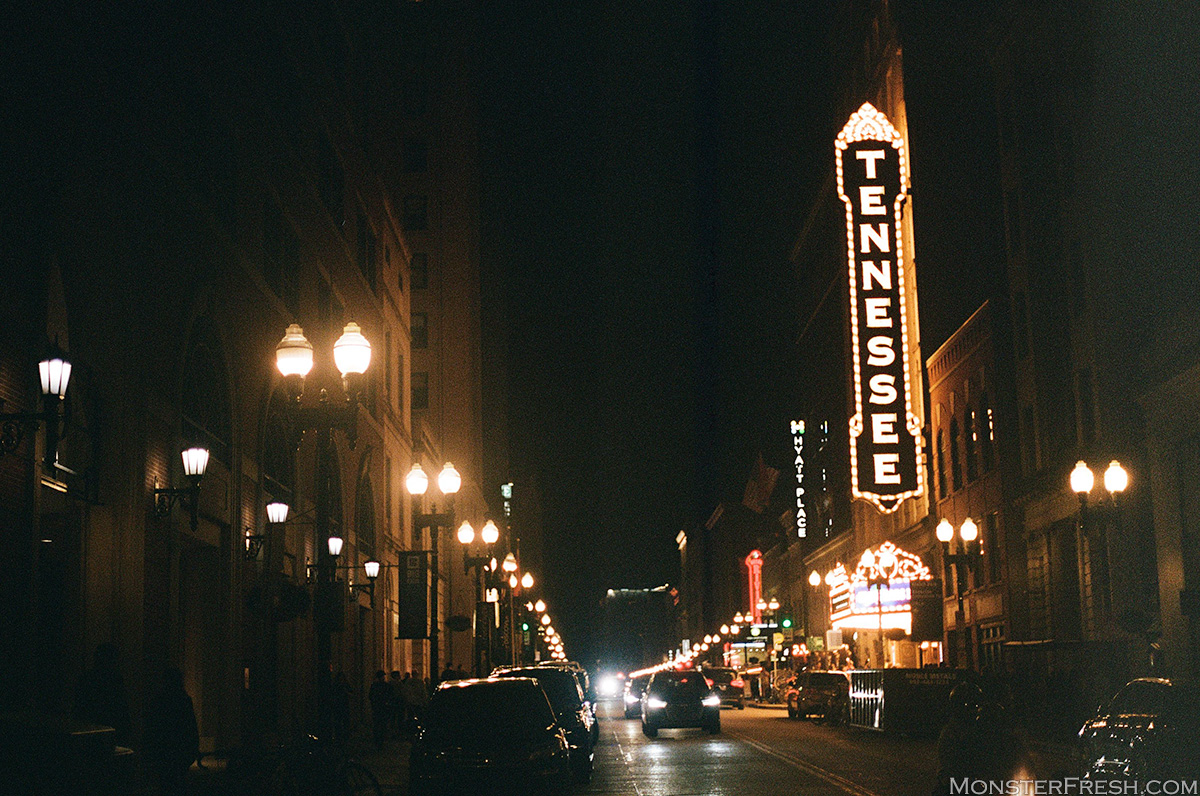
Since 2009, Knoxville, TN, has been hosting one of the most impressive music festivals in the country. Behind the annual gathering is an independent 501(C)3 non-profit named, Big Ears, which was established around the mission “to collaborate with artists, audiences, and communities to create joyful, meaningful, and transcendent cultural experiences that defy boundaries, fuel curiosity, ignite the spirit, and nourish the soul.” As for their flagship event, Big Ears Festival claims to “explore the influences that inspire and connect musicians and artists, crossing the boundaries of musical genres as well as artistic disciplines.” In a 2019 interview with Knox News, Big Ears founder, Ashley Capps, suggested that, “perhaps the festival’s reason for being is to invite people to explore the extraordinary world of music and to do so in a way that is fun and exciting and open and encouraging.” As someone who just attended my first Big Ears Festival ever, I can confirm that each of these stated aims was more than successful. While that’s true, we’re still processing everything we experienced and are fully aware that we barely scratched the surface.
The festival has expanded quite a bit since its inception, but even in its more stripped-down inaugural year, the lineup featured such notable acts as Philip Glass, Michael Gira, Anhoni & The Johnsons, and Negativland. Also included was a trio comprised of Australian electronic/noise producer/guitarist Fennesz and Sparklehorse members Scott Minor and Mark Linkous, the year before the latter passed away. These types of collaborations have become a staple of the annual event, with artists taking rare opportunities to work together, often in last-minute or impromptu performances. Along with the unbelievably stacked lineups, seeing artists experiment and blend their disparate sounds is one element that makes the Knoxville festival so unique. There’s a reason that thousands of people travel out for it each year and why tickets consistently sell out. Things are happening at Big Ears that you won’t have the opportunity to witness anywhere else.
The greatest aspects of Big Ears also tend to create the biggest obstacles. As the festival website explains, “every spring, Big Ears presents nearly 200 concerts, talks, workshops, film screenings, residencies, and more in over a dozen venues across downtown Knoxville.” These venues range from a small curtained-off space in the back of a Scottish pub to the 2,500-seat Knoxville Civic Auditorium. Performers aren’t restricted to the usual time slots of most festivals, either. Some sets can last 2 hours or more, while others run for half the time. Best/worst of all, just about everything on the bill could take priority at most festivals. Planning your schedule involves considering venue sizes, overlap of conflicting shows, proximity of one set to the next, and, ultimately, cutting out some major draws in favor of others. In other words, there’s way too much great stuff to see all of it. As someone who had never been before, the best I could imagine was an abstract idea of the layout and what I was getting into. Fortunately, I had more than one person eager to break it all down for me.
Despite consistently booking one of the greatest – if not the greatest – lineups in the country, Big Ears has mostly hovered under the radar. To their benefit, what they lack in mainstream attention is more than made up for with a dedicated, vocal fanbase of true believers enthusiastic to sing their praises and welcome you into the fold. Last July, I made friends with one such character at a Horse Lords show in Seattle. We’ve kept in touch, and as this year’s festival approached, he began DM-ing me general info about the setup, venues, and surrounding areas, along with his detailed plans for navigating the schedule. I’d already been dreaming about making it out there at some point, but running into him and other Big Ears regulars over the last year forced us to get serious about finally making it a reality.
RICH RUTH
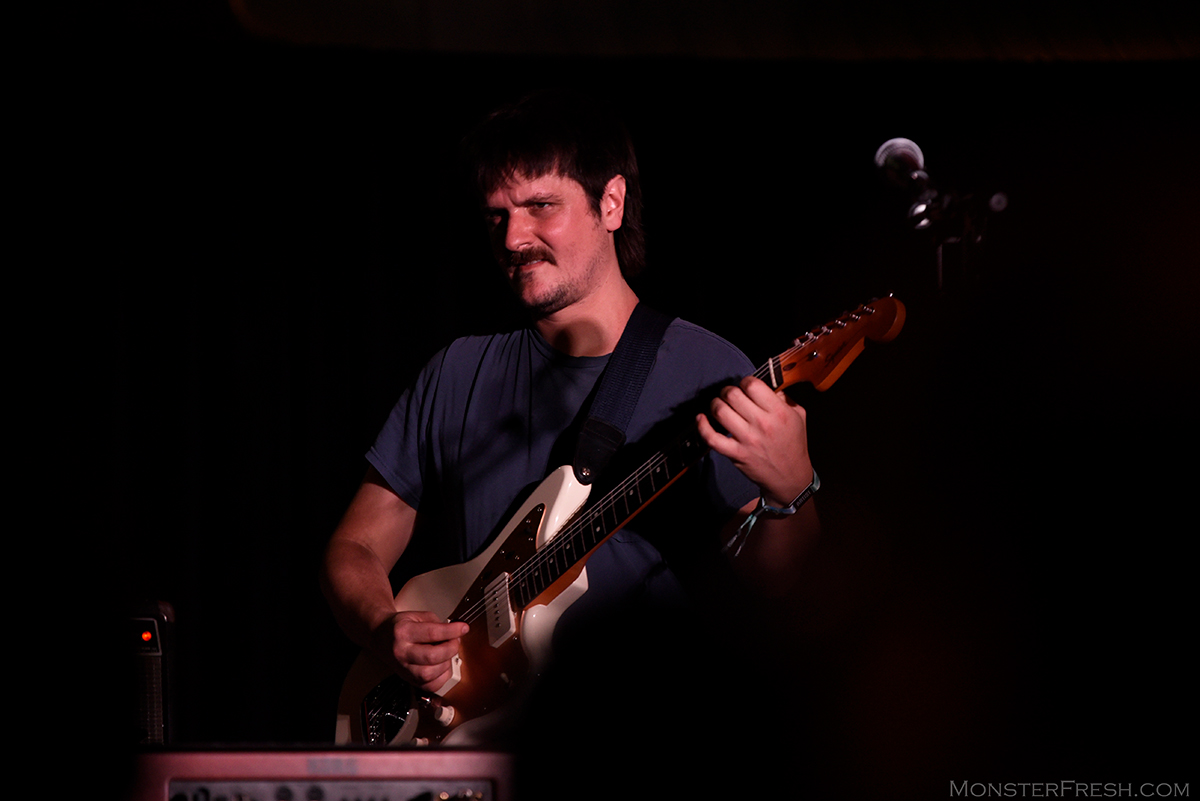
There could be no better advocate or ambassador than Big Ears veteran Michael Rich Ruth. The festival maintains a focus on jazz, experimental, krautrock, and ambient music, all elements that are present in the multi-instrumentalist’s solo work. With his history as a mainstay of the Nashville music scene, frequent sideman, and a touring guitarist for Kentucky singer/songwriter, SG Goodman, Ruth has also established his proficiency in the more southern-tinged roots music represented in the lineup.
I first met Michael at Pickathon 2023, when harpist Mikaela Davis sat in with his spaced-out ambient spiritual jazz outfit, Rich Ruth. In addition to his own Big Ears set, last year, he was part of an “all-star” backing band for guitar virtuoso, Yasmin Williams, alongside guitarist, William Tyler (Silver Jews, Lambchop, Bonnie ‘Prince’ Billy, etc) and cellist, Austin Hoke (Cage The Elephant, Amanda Shires, Over The Garden Wall OST, etc). To have a multi-genre festival in his home state, where innovators at the highest level in their fields can experiment and collaborate, is like a playground for someone like Ruth. In a DM a few weeks before the festival, he told me that “it’s by far the best festival out there [both] as a patron and artist” and that he’d be there even if he wasn’t performing. Promising that I would “love it,” he stated that, “pretty much all the rooms are great, Knoxville is super chill and nice this time of year, and the variety is unparalleled.” He encouraged me to hit him up if I had “any questions or anything,” adding, “This will be my 6th one, I think.”
Rich Ruth was the first act we caught on the first day. His set took place at The Standard, a 1930s glass manufacturing building-turned-event space with exposed brick. The ensemble was 7-deep this time around, consisting of Ruth (guitar/synths), Sam Que (sax), Taro Yamazaki (bass), Taylor Floreth (drums), Patrick M’Gonigle (fiddle), Spencer Cullum (pedal steel), and Parker James (vibraphone/percussion). With its hypnotic waves of spaced-out spiritual jazz, a Rich Ruth show is a sonic journey to be experienced more than anything. As a bandleader, Michael has a gentle touch, doing just enough to keep the wind in the sails, while entrusting the talent he’s assembled to explore freely. The music isn’t entirely amorphous, but it never stagnates. Rather, it swells, breathes, growls, soars, and mutates, forging and venturing into different pathways. The formula seems simple: if they expect the audience to zone out to the music effectively, they need to get lost in it themselves.
The show ended with the band bringing out multi-disciplinary outsider visual artist and improvisational musician, Lonnie Holley, to join them on vocals. When it was over, Ruth hugged his guest and told us the story of how he wandered into a set by Lonnie 11 years ago, and his mind was blown. It was the first performance the guitarist had ever seen at Big Ears, so this was a full-circle moment for him. I’m not sure how planned the appearance was in advance, but I spoke to Lonnie outside the show, and he informed me he had just pulled up and “parked illegally.” Ruth‘s enthusiasm for the festival is infectious, and it was evident that he had plans to wring as much out of the weekend as possible. We were going to try to do the same.
Big Ears not only presents an ideal outlet for artists to explore, collaborate, and experiment, but also a prime opportunity to debut new projects and material. I initially contacted Ruth to ask if he was playing any additional sets in case we were forced to miss the one on Thursday. He responded with, “Doing a secret one on Friday! Unveiling this new project I’ve been working on with Allison De Groot (insane banjo player).” “We’ve been making this crazy record for the past year. It’s like Appalachian Terry Riley.” FUUUUUUUCK! I was hoping he might offer some relief from the torturous scheduling conflicts, but instead, he revealed a new one. I was now going to have to choose between that and the brilliance of the Jeff Parker EVA IVtet, but I could sort that out when the time came. If nothing else, I would see Parker with his band Tortoise on opening night.
TORTOISE
The morning before the festival, we received an email announcing “New Music from Tortoise Exclusively Available to Big Ears Attendees!” Offered to us 24 hours before the general public, the song “Organesson” marks the first new music the post-rock pioneers have released since The Catastrophist LP in 2016. The track foreshadows “a larger body of work” arriving soon. The email also promised that their Thursday night set at The Mill & Mine would include “several new pieces of music in addition to classics from their more than three decades-deep catalog of boundary-defying, vanguard-defining music.” I’ll always see Tortoise if I have the opportunity, but this news further softened the blow of them overlapping a set by Beth Gibbons. With her Portishad co-founder, Geoff Burrow, on the bill with his electronic rock trio, BEAK>, it feels like a lost opportunity for a collaboration between the 3 projects.
NOTE TO BIG EARS: Look into booking TORTISHEAD in 2026.
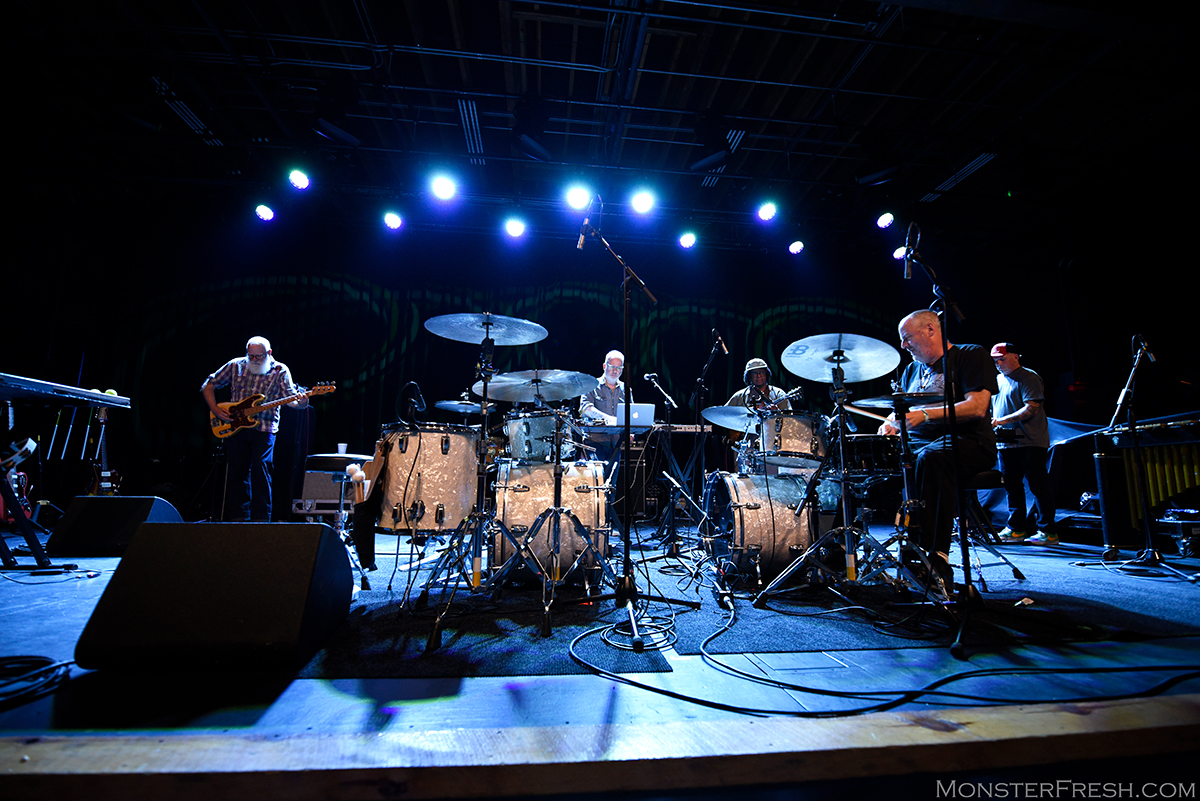
Tortoise began with a new track, sprinkling “Organesson” and another unknown song into the mix as the show went on. Blending minimalism, jazz, dub, electronica, krautrock, and whatever else inspires them or naturally generates from their DNA, they have always had a sound that refuses to be pinned down. Simply put, Tortoise sounds like Tortoise. The new songs fit right in, as older material was well represented, particularly from the albums TNT (1998) and Standards (2001). The band finished their set with fan favorite, “10-Day Interval” (TNT), before concluding with “Eros” and “Seneca,” both from Standards. The majority of the crowd was fixated on the stage, except for one guy who whooped and hollered, while jumping up and down, shaking the barricade.
I’ve always viewed Tortoise as one of those irrefutable live acts with the potential to win anyone over. The spectacle of 5 multi-instrumentalists rotating the stage is a sight to behold, particularly when it comes to percussive elements like the dueling drums or the intertwining vibraphone and marimba. Every member is involved in other projects, and although the band has continued to perform since their last collective release, it usually results in only a handful of shows a year. It’s remarkable how they reform so effortlessly, and this was as good a Tortoise show as I’ve ever seen. It was also one of the only times I’ve shot them in a venue with an actual photo pit.
THE MILL & MINE
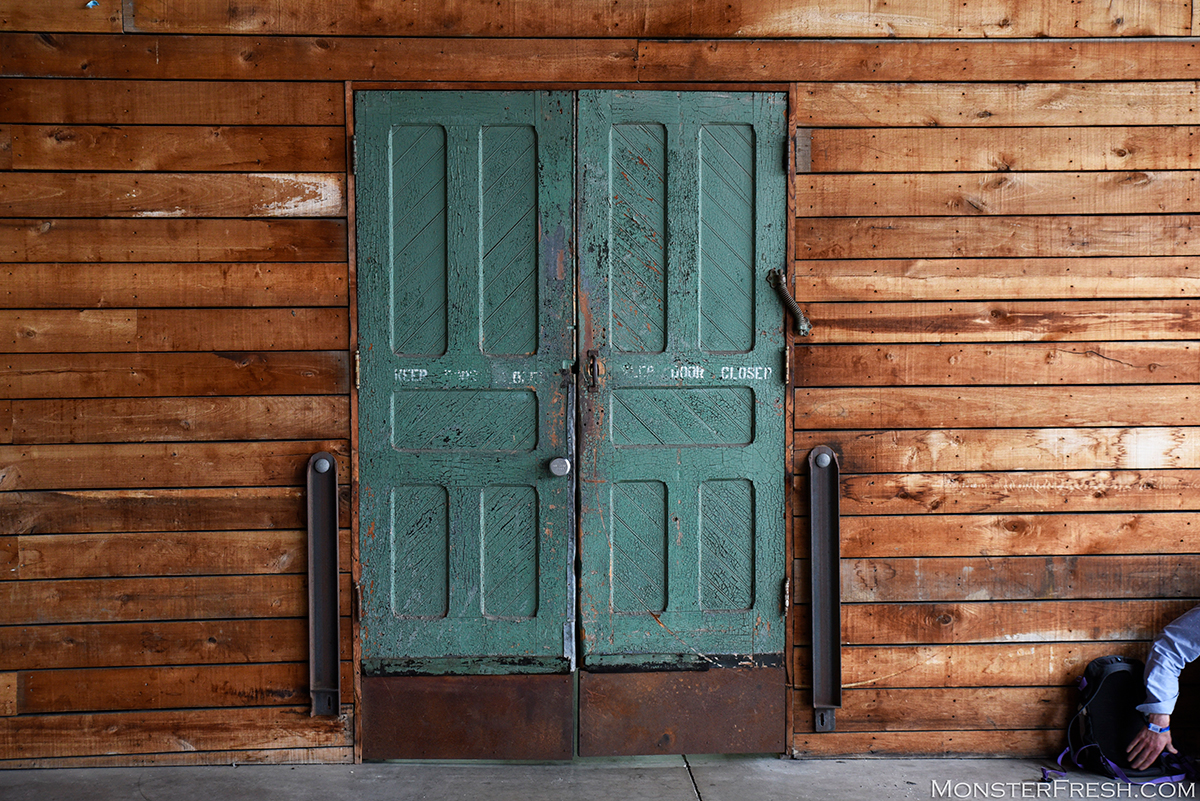
Out of all of the venues, The Mill & Mine seems like the type of mid-sized space that regularly books contemporary acts in the city. They’re designed for this sort of thing more than a multi-purpose room, historic theater, museum, or cathedral being repurposed for the event. I love all of the variety at Big Ears, but I get the impression that a concert like this is a regular occurrence for The Mill & Mine. With its open layout, hardwood floors, and exposed brick, it’s a beautiful space. There’s an open loft for VIP ticket holders, and a bar at the back. If you need to get some air, there’s even a courtyard with a canopy area equipped with monitors streaming the performances. The weather was mostly great, and I saw several artists hanging out in that area throughout the weekend.
I ran into multi-instrumentalist/producer Cooper Crain (CAVE, Bitchin Bajas, Warhammer 48k) while heading to see Tortoise. I met him the last time I was in Nashville in 2018 at what he tells me was probably the last CAVE show to date. He was standing on the street with Helado Negro and drummer/bandleader, Mike Reed, whose project, The Seperatist Party, features Cooper and the other members of Bitchin Bajas. Throughout the weekend, I would run into or meet performers through similar circumstances, including Trevor Dunn (Mr. Bungle, Fantomas, Tomahawk, Melvins Lite, John Zorn); painter, banjoist, and Pee-Wee’s Playhouse artist, Wayne White; and Deerhoof drummer, Greg Saunier. One night, as we walked by Greg on the street, I overheard him enthusiastically discussing how many friends he’d bumped into at the festival. Big Ears really does seem like an amazing place for artists.
Cooper, Mike Reed, and Helado Negro ended up at the Tortoise show, as did Rich Ruth and his crew. Also in the crowd was Nick Sanborn, the only person I’d see more over the weekend than Saunier. Sometimes, Sanborn would be accompanied by Amelia Meath, his wife and partner in Sylvan Esso. When I spoke to him at The Mill & Mine, he explained that they were in town to support several artists on their label, Psychic Hotline. It’s a great label that I didn’t know they were behind. Among the Psychic Hotline artists performing were Phil Cook, Amaro Freitas, and William Tyler, who we were heading to see next.
WILLIAM TYLER
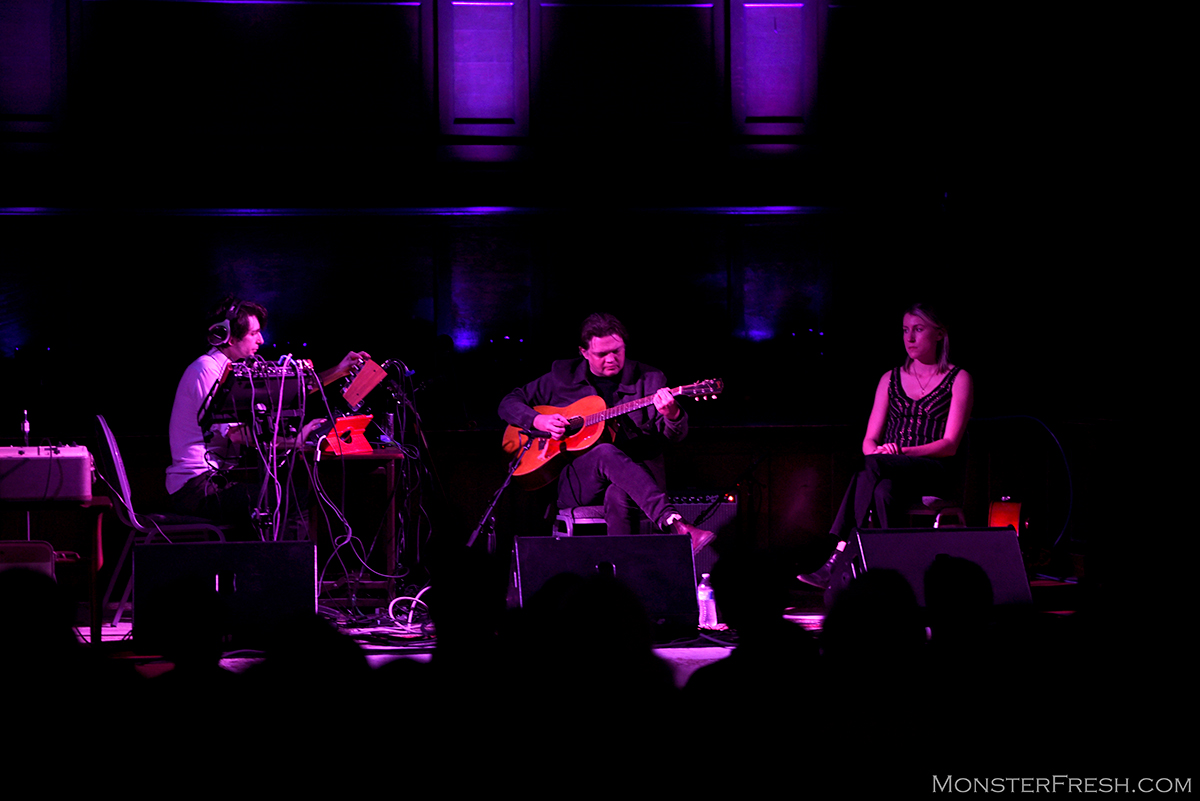
William Tyler performed at The Point. With its enormous columns, oversized doors, and cement stairs, the square brick church resembled an old-timey bank or historic monument. The Big Ears website describes it as “a serene and intimate setting […] where audiences can connect deeply with the music in a calm, reflective environment” and “experience a powerful intersection of community, spirituality, and artistry.” I’m not sure how much of that description comes from the church itself, but they promote themselves as a welcoming place of worship for those who feel rejected by other churches for various reasons, be it tattoos or checkered pasts. Whatever the case, the space was ideal for zoning out and being swept up in sonic landscapes the Nashville guitarist conjured up for us that night.
The first time I witnessed Tyler at work was in 2008 when he toured as a member of Silver Jews. Years later, I would see him lead his own project while employing a more pastoral yet dextrous finger-picking style reminiscent of guitar heroes like John Fahey. On this night, we would be treated to another exclusive, as he performed his yet-to-be-released LP, Time Infinite. Samples of the project were released in February, each paired with home video footage of his family. Inspired by the discovery of an old tape machine in his late grandfather’s office, his first solo album in 6 years finds William recruiting friend/producer, Jake Davis, to help create tape loops and layer sounds in ways he’s never attempted before. Presented as a project that “rewards intentional listening,” the last of 3 scheduled listening parties with the artist took place in Knoxville the night before as a pre-festival event. We missed that, but seeing him unveil the new material live in a small church more than made up for that.
Viewing from the wrap-around balcony, I noticed Yo La Tengo‘s Ira Kaplan and Georgia Hubley slip into a pair of seats not too far from us. Tyler sat before rows of pews flanked by Jake Davis and cellist, Cecilia Stair. William blended effected guitar with warm strings, as Davis played synth, turned knobs, and manipulated loops through the found tape machine that inspired this collaboration. The guitarist played a cassette recorder into the pickups of a Gibson SG and held a pocket fan over the sound hole to vibrate the strings of his acoustic. Large waves of abstract nostalgia poured from his trusty Deluxe Reverb amp, wooshing over the room and dissipating like sunbeams glinting off a brook. Haunted lo-fi samples ricocheted like laser-guided boomerangs. Fading thumps boomed, then echoed, as if summoned from the bowels of a dampened cellar. The sound bath rose to fill the balcony from below us. Tyler and his accomplices offered an emotional experience that fluctuated from soothing and tranquil to ominous and unsettling, organic and earthy to atmospheric and industrial. Vignettes of eerie spectral samples absorbed into American primitive guitar work like some hybrid between Caretaker and Robbie Basho. The elements at play are not completely unfamiliar to the songwriter, but he’s definitely utilizing and evolving them in new directions. If Time Infinite sounds anything like what we experienced, this is going to be a release to look out for.
DARKSIDE
DARKSIDE closed out Day 1 back at The Mill & Mine. I’ve always enjoyed the more left-field, spatial electronic work of Nicolás Jaar, but I’m not sure that I really connected the dots that the Chilean-American composer was part of this New York outfit. I’d heard some DARKSIDE in the past, but nothing really stuck with me, other than the fact that they were an electronic duo with some hype behind them. A slightly more mainstream act than many others on the bill, I figured I might as well use this opportunity to see what they were all about.
I’d later learn that Jaar met partner, Dave Harrington, when they both attended Brown University, and the former was recruiting people to back him during live performances. They formed DARKSIDE in 2011, released an album in 2013, and went on an indefinite hiatus the following year. Jaar pumped out a bunch of solo material, while Harrington explored areas of dark-ambient and jazz through solo and several collaborative projects. I mostly started hearing about the group when they reformed at the end of 2020 and began releasing a smattering of singles that would become the album Spiral (2021). To tour the release, Jaar and Harrington recruited old friend/collaborator, Tlacael Esparza, who previously stepped away from live performance to create a revolutionary hardware interface for drummers. Released as a product in 2015, Sensory Percussion enables drummers to smoothly trigger, shape, and modulate samples via their own kit while playing. In 2023, this new 3-piece version of DARKSIDE released Live At Spiral House, comprised of material recorded in their rehearsal space. Their latest studio album, Nothing, just dropped at the end of February.
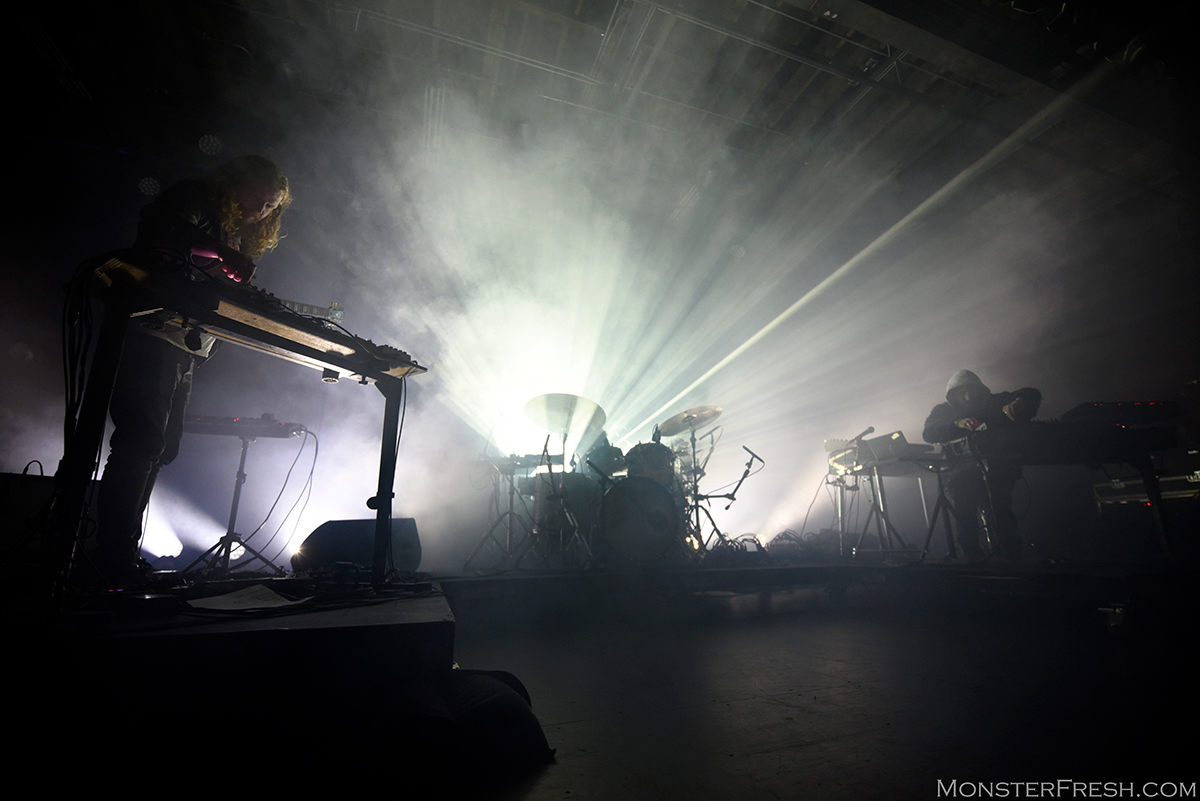
I can’t speak to any former incarnation or comment on how particular tracks translated live; I have no reference for that. What I can tell you is that, as a trio, DARKSIDE is an undeniable force and that I am now a fan. On the right side of the stage was Jaar, seated among keys and electronics. Harrington stood across from him, wielding his guitar behind a table of knobs and effects. A synth was mounted on a stand to his side. Set back in between the pair was Esparza at his modified kit. Each member operated from their respective stations, deeply focused on the individual contributions they would release into a menacing, swirling gumbo of doom and salvation. There were times when Jaar would sing, but DARKSIDE is more about creating worlds than pop hits.
Heavily shrouded in smoke, they were backlit by bursts of illumination that rendered their images as little more than silhouettes. The visuals mixed with their hybridized onslaught of live instrumentation and electronic chaos make a DARKSIDE show feel less like a concert and more like the members are operating a weather machine. These aren’t sterile EDM affairs. They are jamming freely, employing technology as a means to manipulate and expand the atmosphere. These cats are on some Ghost In The Shell trip, the way they blur the line between soulful grooves and cold electronics to forge something that isn’t entirely either. At times, it feels ritualistic. Are they locking us into the tractor beam of a massive UFO, or opening up a portal to the underworld? All I know is it was a great introduction to the band and the perfect way to close out the first night of the festival.
We finished our time downtown by wandering down a stairwell into a tiny subterranean karaoke bar. The humble watering hole was full of locals who either didn’t know there was a festival happening all around them or simply didn’t care. A girl from out of town sang “Hunger Strike” by Temple Of The Dog and then preached to the room about the importance of educating themselves on the legacy of Andrew Wood. We eventually called an Uber and headed back to the rental. We had 3 more days ahead of us.